Wired

Man on Wire

Man on Wire

“You sure must drink a lot of coffee.”

“I haven’t had a drop since I started this job.”

“Wow. How do you do it, then?”

“I’ve never fit in and staying up all night is easy for me. May as well get paid for it.”

I knew from a young age that I never fit in with the other kids. Not only did I sit down in front of Sesame Street but I’d also watch the evening news and The Nightly Business Report when I got a chance. When I was in the library in elementary school, I’d grab whatever reference book or Encyclopedia struck my fancy and go through it until I found something that stood out to me. When my parents got  lost behind the wheel, I was the one who knew where we were and which directions would get us back on track. I was intellectually hungry to know how, where, when, why, and what made people tick. Much of that curiosity was satisfied when I went to New York alone for the first time in early ’94 and drove out to California alone a little over two years later. There were no words to describe what it was like to see the words, pictures, and stories in books and depicted on television come to life right in front of me, as I got to use my knowledge and take my learning to another level by experiencing new places firsthand.

One of the moments I’ll never forget was the first time I drove out at night alone. I had just gotten my license and a pair of wheels (not much else functioned properly on that vehicle) but on a night not much unlike tonight, I took her out for a spin here in town. It may not have seen like much to anyone else but to be out alone with the buildings illuminated by artificial light, with hardly a soul to be seen, and with the top down on a room-temperature night was something that struck me as totally new and totally comforting at the same time. Most of all, I wasn’t tired like so many people were when they had to be out late for work or socializing. I begged to stay up past my bedtime when I was little to watch Sha-na-na or Dance Fever and even though they had been off the air for years by that point, the little boy that resented going to bed early finally got his due and loved every minute of it.

Looking back, it was easy to see why I loved that night and so many others like it since. Every job where I’ve had to be up during the day had been a struggle for me – from getting out of bed, staying awake and alert for the full 8 hours, and conforming to an office environment that never felt quite right, even on the best of days. One thing I learned during the struggles of a daytime vocation was that I had to keep myself stimulated in order to feel alive. No, it didn’t involve illicit substances or death-defying juvenile antics, but I had to read, write, learn, listen, and respond to as much as I could and add it to my base of knowledge, so I could find new fields that explore on my own time.

Even with all the books I have here at the house, all the pages bookmarked on my computer, and all the places I’ve been lucky enough to visit in the other 46 States that I don’t regularly get to, there’s so much more out there that I haven’t been able to have my senses come into contact with. The older I get, the more I realize that what I’ve learned will probably pale in comparison with what still currently remains unknown to me. For example, there’s the World Trade Center and a chapter of its history that I only recently started to inquire about further.

Several times in the 1980’s, I had the chance to go to the observation decks on the 107th and 110 floors. I remember the absolutely massive escalators leading up from the PATH terminus, the elevators having “Welcome” written in several languages for the tourists, photographs of each of the 4 views with the major buildings highlighted for the sightseers, the electric fence around the edge of the outdoor observation deck to thwart jumpers, and an autograph on the northwest corner of the South Tower, with a simple marking on it. Later on, I realized that someone had crossed between the Towers on wire around the time my parents got married, but I never read any further into it.

Three months before I graduated from Columbia, I stumbled into the auditorium at the Student Center where I had reviewed notes for class during many a lazy afternoon. That day, they were screening Man on Wire with a Q and A afterwards with one of the deans. It was free and open to all and even though I missed the first 15 or so minutes of it, I put my books away, sat down, and stayed until the end of the discussion.

I would tell everyone out there reading this to go rent it on DVD and watch it straight through, but that’s not why I’m writing this entry today. For starters, this isn’t a blog about movie recommendations and furthermore, I hadn’t been to a theater in years before watching that documentary; so therefore, I have almost nothing to use as a frame of reference. Most people I know have seen so many movies that they know what they like and don’t like and what they think of the most popular films in recent years. I’m the exact opposite as I have little use for Hollywood right now and spend my free time pursuing other forms of mental stimulation.

All of that is besides my point, however. Like so much else in life, it wasn’t the crossing that was amazing as much as the story behind it. It’s impossible to envision someone being able to freely walk into the construction site down at Ground Zero today once night sets in but Philippe Petit and his assistants did just that when the original World Trade Center was under construction in the 1970’s. The whole operation was so meticulously planned that the details behind the “artistic crime of the century” were nearly amazing as the actual act itself. Mastering the art of tightrope walking, gaining access to the construction site, learning the layout of the towers, and accessing the roof seem difficult enough, not to mention having to breach whatever passed for security back in those days. It may seem like a lot of preparation for an event that may never have happened, but when asked about it afterwards, he had this to say in his defense:

“When I see three oranges, I juggle; when I see two towers, I walk!”

And so he did.

It’s so difficult for me to look at those pictures nearly 40 years later. It’s not because the towers aren’t there anymore, or because the landscape of Lower Manhattan has changed, or the color resolution has changed 1000% for the better, or even because the air of today’s postindustrial Gotham has become cleaner than clean itself. It’s because I keep thinking that he’s absolutely, totally insane for what he did.

But there’s no doubt that he isn’t.

Sitting on the physical edge of 110-story towers as if it was a simple ledge is something that no one else would ever want to do, but he wanted to do it. He had a goal, a way to attain it, and the patience to follow through. Who am I to criticize him? There was a time when picturing machines heavier than air gliding effortlessly around the world, or messages being sent to anyone, anywhere, anytime at the click of the button, or even diseases invisible to the naked eye being wiped off the face of the Earth would have seen eternally impossible but someone had the courage to challenge the status quo and push the boundaries past the known realm to see these ideas become reality.

No matter how preposterous it seemed or how much effort was required to carry out the dream.

From what I have read, some have criticized Petit for what they perceive as his enormous ego. I never thought it was big at all and unless one completely clouds out friends, family, and spirituality, it’s almost impossible to have one’s Freudian impulses out of whack. It was ego that sent explorers across the Atlantic in search of riches, new lands to conquer and ultimately, a new home away from crowded, feudal Europe. Ego led to the writing of a document that separated us from a country intent on plundering our wealth of resources instead of treating us as equals under the law. Years later, ego led to the laying out of the “greatest grid” of streets in the greatest city in the republic which had the courage and daring to break away from the largest colonial power the world had ever seen. A few generations later, ego after ego took part in the greatest race for height of the 20th century, which ended in the construction of two massive towers that were over 95% full on the day they were destroyed at the dawn of the 21st century. Each age of individual gain involved less and less physical space that had to be conquered than the one before it but involved more mental blocks that had to be overcome, as the World became smaller over that time but the contents of it became larger and more complex, and therefore, presented more challenges for those that wish to rise over them.

All of this came to a head on August 8, 1974 as millions watched mesmerized during Petit’s 8 walks back and forth between the towers over a 45 minute span. One Police Officer who watched knew that he’d never see anything like it again but little did he know how utterly prophetic his words were. It was apparent that day that no one would ever string a wire between the towers and use them as a means of crossing the 1,300-plus foot height of their rooflines again. What was not obvious that day was that we’d never push a boundary like that on U.S. soil in anyone’s lifetime.

Sure, new companies have been formed and new inventions have come along that have revolutionized the workplace, the standard of living, and the way people interact with one another, but so much has changed in this country that it’s increasingly hard for one big idea or one big person to come along and challenge the conventional wisdom of the day. Groupthink, conformity, increased domestic surveillance, and a security state have all led to a dearth of creativity that will hurt America for generations to come; assuming that the Republic even survives in its current state for that long. Toss in another fiscal collapse similar to what happened 5 years ago and it could be the end our way of life forever.

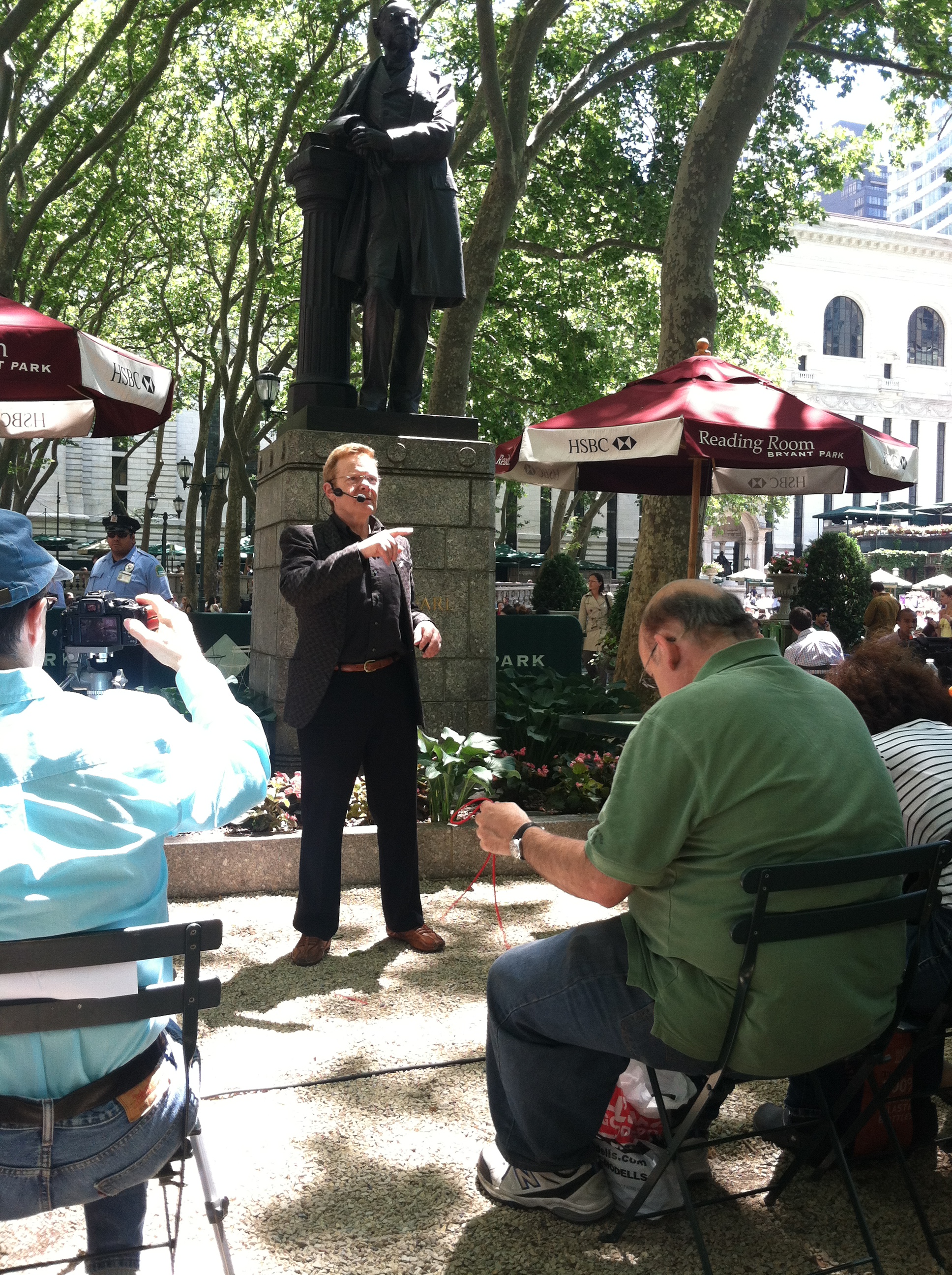
A few weeks ago, I went into Bryant Park after a night out at work which saw me interact with the usual cast of characters that I come across during a typical shift. None of them measured up to the person I had gone to see in the reading room that day. Vivacious, humorous, and uplifting, the 63 year-old that spoke that sunny afternoon was there to promote his latest book, which dealt with knots. Seems like a simple premise until you realized that the person had been tying and retying knots for decades and that that person was none other than Philippe Petit himself.

It was one of those days that stuck with me for a long time after I paid for Why Knot? and To Reach the Clouds. Once again, something that I had only seem in film and print had come to life before my eyes, much as the places in New York and America had for me during my jaunts away from my cozy suburban abode. The crowd that grew was much larger than anyone had anticipated as those walking by through the park or on their way back to the office after lunch realized who was speaking and how he had everyone’s attention who was in attendance. Most striking of all were how many people that were in the park that day were *not* aware of the speaker at all but rather, were on their phone/Blackberry or idling the time away in the midst of a presentation by one of the most engaging personalities ever to set foot in the Big Apple.

When it came time for me to have the books autographed by him, I mentioned that I was surprised that he wasn’t left-handed. Not only is yours truly sinister in the way my brain is wired, but nearly all of the women that I’ve most admired and have been attracted to over the years and many of the notables that I’ve emulated were in the minority when it came to which hand they’d place a writing utensil in. Philippe mentioned that he was indeed right handed but thought of himself as more ambidextrous than just about anyone else.

Surely, who would argue with that?

Before I left to shoot my first rounds of Petanque in weeks, I told him wholeheartedly that he was beloved in New York. While I’m sure he’s been told that more times than I could count, I’m sure it’s something that one would never get tired of hearing. Personally, it would be something I’d want have someone  tell me, though I wouldn’t be sure for exactly what I had done with my life and my God-given talents.

And that’s where the problem lies.

The old Chinese saying is that a journey of a thousand miles begins with single step and for me, the problem is figuring out what direction that, and the thousands of others that come past it, would be in. Years of reading, writing, and schooling have shown me that for all that I know and have codified, that there’s much out there that I have yet to learn and accomplish. Every time I think about how hard it is, I pull up the picture of the view down from the South Tower of the World Trade Center as Petit took his first step and danced among the clouds on that Summer morning decades ago.

I’d give anything to experience that feeling for myself someday.
Man off Wire

Man off Wire

Meet the Met

Dressed to the nines

Dressed to the nines

As many New Yorkers were well aware of, the Metropolitan Museum’s annual gala was held this past Monday. Of course, yours truly worked that night, as has been the case nearly every Monday night for the last year and three-quarters. Given how slow New York tends to be on the first workday of the week, it was a notable event for me since one of my fares needed to get up Madison Ave. at 6:30 that night. Sure enough, I never got my passenger to her destination as the combination of black cars, taxis, buses, and flashing lights combined to bring the thoroughfare to a halt. The person I had in my cab understood the circumstances, asked me to turn down 72 St, and quietly paid her fare.

Once that ended, I was on with my night. It ran like any other Monday with the exception of my way back down 5 Ave. after dropping off a few fares off in the 90’s off of Park. I didn’t know what to expect since I did not work that night of last year’s gala and I wasn’t sure how many black cars would be idling in the street.

Of course, that turned out to be an insanely high number.

Readers of this blog already know of my disdain for the for-higher-vehicles that match the color of night and tend to fly like it as well. Yes, they have an important role in the transportation economy of the City, as any corporate hotshot or celeb will tell you but for the rest of us, they can be hell on wheels. Rarely do I see one get pulled over for a driving infraction or an illegal street hail and even more rare than that will be a ticket issued to one for idling in the street too long and double-parking. There was lots of both of those as I snaked my way downtown and made my way past New York’s premiere social event of the year.

Given how nightlife and society have changed over the years, the Met Gala is arguably the last annual event that draws a red-carpet ambiance to the Big Apple. Awards shows and ceremonies like the Tony’s draw a niche crowd while larger events like the Grammy’s rotate between venues every year. Film premieres will showcase those starring in them as well as other flash-in-the-pan types that are hot at the moment and none of the ones that I drive past or read about in the paper seem to have the pizazz of those during the heyday of the Hollywood Studio system. What we’re left with is a museum hosting the only event left of its kind in New York, but even that has changed over the years.

As the above link succinctly states, the event was originally known as the Metropolitan Museum Fashion Ball. Yes, that’s right – fashion. Not shamu’s begging to attend and showing up in couch retreads, but an actual event attended by society’s elite in gowns that were part of the Museum collection. Patrons were rewarded for their financial generosity and the list of attendees read like a Who’s Who of elite in New York. Most of them were not known by the general public and the event had the appearance of debutante balls and “coming out” events that helped to characterize the gilded age.

And then Anna Wintour entered the picture.

What fun would it be to have the largely-unknown constituents of the upper crust attend the event each year when celebrities that people could identify with more would be a bigger draw and hence, make the event more newsworthy? Just as she changed who appeared on a coveted magazine cover each month, she used her sway to determine who would get one of the exclusive invites each year. Not since Studio 54’s short but brilliant reign as the center of Gotham’s nightlife were socialites, models, designers, singers, dancers, actresses, the affluent, and just plain popular able to come together in one place at one time. I couldn’t help but notice the similarities between the two as I saw throngs of those wearing Halston and Diane Von Furstenberg screaming to get into Rubell’s and Schrager’s haven of hedonism on youtube videos, just as throngs of spectators stood behind metal barricades on Monday night. Some twisted part of me wishes they were rooting me on as I made my way down what is still regarded as New York’s most glamorous avenue, but reality sunk in as yet another vehicle stopped in front of me and threw its flashers on. Those who were waiting for hours outside for a glimpse of those who could care less about them would never see the folly of their ways.

One could also make the argument that those they were screaming for were also fools in their own right, as the cost of admittance to the invitation only event was rumored to begin at $5,000. While the cost of admittance was never cheap, it was originally borne by those who had a stake in the Museum and the exhibits that were shown there. The theme of this year’s event was “Punk: Chaos to Culture” , which was perfectly fitting given that the embrace of the grungy, industrial chic that punk espoused has come full circle nearly 30 years after it’s original heyday. Those who actually dressed up in punk outifts for the gala probably weren’t alive in the late 70’s and early 80’s. just as they’re unlikely to visit the museum and see the accompanying exhibit that ties in to the event. That’s not an issue since it’s prestige and fundraising that came first and not the chance to renew ties with those responsible for the exhibits that are curated there.

A few of the yellows that were in crawling in line with me picked up passengers leaving the event but it was a big o-for for me. About 10 blocks down, I picked up someone nicely dressed who was loosely tied to the night’s festivities:

“Hey there, where to?”

“Park and 22nd.”

“Sure thing.”

Once she was off the phone, I chimed in as appropriately as I could:

“I bet you had something to do with that soiree back at the Met.”

“Yeah (laughing), I did. I work for one of the hotels near there and it’s been crazy today. I had to make sure that everything went off without a hitch for J. Lo. Tomorrow begins the real work as I have to write all the press releases for those staying at our hotel. The work never ends…”

Maybe their life isn’t so different from mine, after all.

Pulse

Racing Taxis - Meatpacking District

Whizzing Taxis – Meatpacking District

“Sorry for the delay, “I’m going to turn off of 7 Ave. South and get away from this Holland Tunnel traffic.”

“It’s all good. I still don’t know what we’d do without you guys. You’re the lifeblood of the City.”

“I know most of us don’t see it that way, but thank you for the kind words.”

Ever take your own pulse? I mean, *really* take it? It’s not that easy for someone who hasn’t been trained. Yeah, I suppose I could check my wrist, count the number of beats in 15 seconds and multiply it by 4. Heck, I don’t even know if it’s the right way to do it but it makes sense to me and should give me an approximation of where I stand. Thankfully, I give blood every 3 months or so and I get a reading of that, my iron, and my cholesterol thrown in for good measure before they stick me and draw some red stuff out for the bank. It’s more than a donation for me, it’s a way to get a small physical of sorts and to figure out where I stand, and what I may need to work on.

Now take 8 million blood-carriers and throw in some tourists, visitors, and undocumenteds for good measure and it’s a much bigger trick. Some people would go straight to the census data from 2010, others would read Crain’s or the New York Times for a week and maybe the superficial would check out the number of derricks in the sky and empty storefronts on the major avenues. The neat thing about my job is that I get to do all of those in a given day for one of the inevitable questions that I’ll get while out at night:

“So how’s business?”

Every winter, there’s a slowdown. How do I know? Because I’ve worked in retail, restaurants, offices, sporting facilities, and the occasional odd job and yes, each one of them saw a downturn after the holidays were over and the champagne bottles were put away. On the street, there are two dead giveaways that you’re in a slow period as a cabdriver, without even having to look at the receipt that I print out at the end of the night:

1) Over night = night’s over

2) Plastic planet

The reason that all of us love to work the weekends is because of the overnight hours and the difference from the same time period during the week. In the midst of all of the app debates that the TLC is dealing with is whether a city as big, as busy, and as street-hail oriented as New York needs a radical change in the way that people find their next ride across town. Rush hours are easy as the amount of traffic on the street and the mad dash of people heading home lead to a 5 or 6 hour period of near-nonstop hails with ability to flip fares easily, just like my tables back from my waiting days. Every night, there’s the time that I call “the wall” where I drop someone off, round a corner, and take a good look up or down one of the major avenues…

…and can see the street again.

The later that point, the better the night for us. Weekends are a different beast, however. There’s a slight lull around 8 or so as New Yorkers are busy home getting ready for the night’s adventures that lie ahead. After that – all bets are off. Last Friday was a perfect example as usual madness was amplified by the first warm day in this area this calendar year. It made for a faster shift since I had everything from interior designers to a bagpiper (yes, he played for me) keep me company and the extra vehicles kept me on my toes as well, filling in nicely for a 3 A.M. snack break.

Going back to the apps, the rationale for their existence is that they would help during slow times, when many of us are cruising the same streets in the same bar districts looking for the same 5 fares. Once in a while, I will turn down a street that looks dead as a doornail, only to find someone standing all by his or herself waiting for a knight in yellow armor to take him or her home safely. While those moments are full of joy and some of my best stories, they’re few and far between.

With an app, that all changes. It becomes much easier to see who’s out there and there they are and would even save us the trouble of waiting in line for people to leave popular establishments and firms that work them to the bone. Most drivers during the week make the exodus out of Manhattan around 1 or so but since I can’t get back to Jersey via mass transit overnight, that’s never an option for me. Knowing where to find people becomes a reality once the City that never sleeps proves that axiom to be partially wrong.

Then there are the payments. Aside from the plethora of late-night holiday parties, the month before Christmas is so beloved by us because people are in a giving mood and aren’t afraid to share the wealth. Of course, they show it to us in the best way possible:

By paying in cash.

I understand that so much has changed when it comes to money in the last few years but one thing that hasn’t is how we wish to receive our fares. Cash is, cold, hard, and instantly usable. If I didn’t have to pay for my own gas and could charge all my expenses and tips on a credit card, I certainly would. After the last fare hike 7 months ago, the percentage of fares that were paid on credit shot up from 50% to well over 60% on most nights, as people couldn’t quite stomach the first across-the-board raise for us in well over 5 years. Once the new year began, that ratio went even higher.

The hangover that many of my passengers had immediately after New Year’s was nothing like the one that they endured in the following months. Some nights, I was lucky to receive 6 or 7 fares in cash out of 25 or 30 total, which barely was enough to pay for my gas and any other expenses. While I always bring change, I never plan on depleting it at the end of the night but I came close a few times. It was obvious that even in a city as affluent as New York, that many locals had stretched their budgets thin and were working hard to cover the difference in their personal finances.

Thankfully, that’s over with now. The ratio has evened out a bit and the amount of vitality in the City late at night has started to pick up again. Even the vital signs are good, as construction, air traffic, Broadway attendance, and hotel occupancy are all healthy levels right now. While there isn’t a direct correlation between those and how much I take home in a given week, any upbeat sign is sure to trickle down to us to some extent.

One way that my health and the health of the City are not inversely related however is something that I’ve mused about time and time again, however:

Clogged arteries.

The last few times I donated blood, my “bad” cholesterol was over 200. Numerous attempts to change my diet, walk more, and get off my butt on off days haven’t made a difference and while it’s not enough to cause me problems, it bears watching as I get older and am more likely to be affected by the buildup. For the City though, clogged arteries are a good sign, as odd as that may sound.

While sitting in traffic may not be fun, seeing it is firsthand proof that things are looking up. Proof that people are out. Proof that people have somewhere to go, Proof that people have money to spend.

And most importantly, proof that New York is moving in the right direction.

Ask anyone in Detroit or Providence how traffic is there and they’ll probably laugh. They’d sign up for New York’s problems in a heartbeat. Traffic, infrastructure that’s bursting at the seams, and high apartment prices are not fun problems to be solved but they’re problems that are the result of a tragedy of the commons, on a different scale. Too many people want to be in New York but there’s not enough room for everyone. Who stays? Who goes? Who gets help from the City?

The next Mayor will have to tackle all of that while not undoing the progress that’s been made since the end of the crack wars and graffiti crises of the 1980’s. While the usual ebb and flow of seasonal volume will continue unabated for time immortal, the body poetic of New York will need plenty of TLC by those entrusted to ethically and honestly watch over the people and finances that they pay into the system. Given recent events that indicate that the opposite has taken place far too often lately, I still believe that the Big Apple is poised for a prosperous and healthy future, bearing that the mistakes of the recent past are not repeated by a new administration next year.

Most people don’t see it this way, but it’s obvious that the vehicle that I drive to earn my living is the lifeblood of Gotham itself. One could argue for the Subway as well but with more lines suffering through shutdowns because of maintenance issues and lack of service in several neighborhoods, the yellow cabs are increasingly the 24-hour option for those who work a nontraditional schedule and are relegated to living far from where they earn their paycheck. Anyone who doesn’t believe me can observe the vehicles making their way across the Queensboro and Williamsburg Bridges every day around 4:30, as the old, tired blood makes its way back to the heart, in exchange for some “oxygen-rich” blood that’s ready to serve the masses until the next changeover.

As odd as it sounds, those yellow cars seem to be in my blood as well, even if it wasn’t what I set out for when I went back to school.

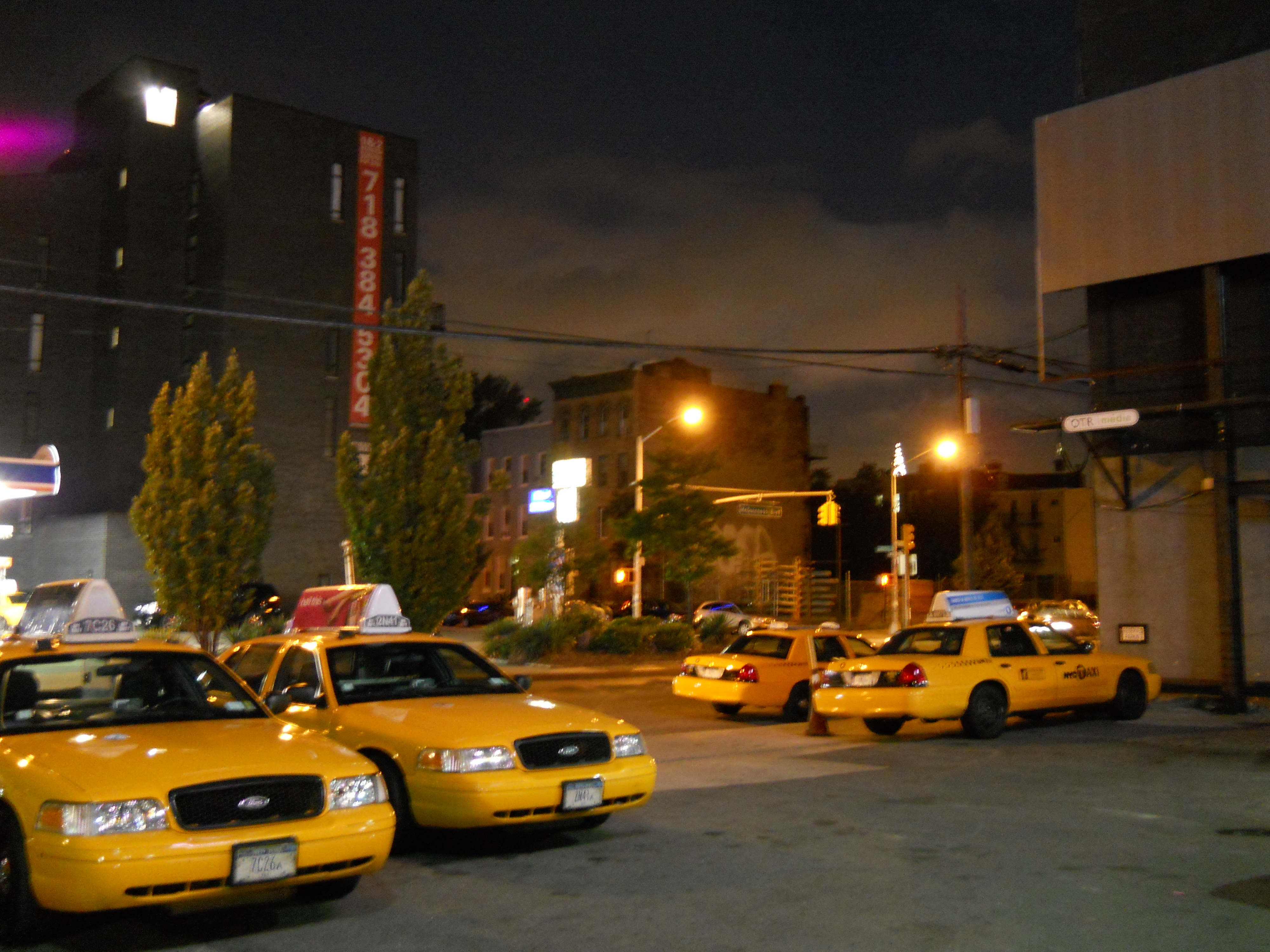
Waiting for the changeover - Greenpont

Waiting for the changeover – Greenpoint

14,600 Ave

Home again, if only for a week - Tempe Diablo Stadium

Home again, if only for a week – Tempe Diablo Stadium

“One, for the cheapest seat in the house.”

Four summers ago, I uttered those words, nearly 100 times. At Minor League parks in 35 states, yours truly was crazy enough to take a whole summer off and watch a bunch of games surrounded by solitude, strangers, and starry skies. A lot happened in the years leading up until March of this year, including a grueling end to my career at Columbia, a renewed love for New Jersey’s finest, and the odyssey behind the wheel that I decided to indulge myself in on a daily basis in the Big Apple. All of that threatened to consume me, leaving a soulless shell in it’s wake. Thankfully, I hit the pause button earlier this month.

As some of you were aware of, I put my hack license away a few weeks back and headed out west. 6 days – all alone – in the Valley of the Sun. Most people just call all of it Phoenix but in actuality, it also encompassed Tempe, Glendale, Mesa, Goodyear, Chandler, Scottsdale, and a few other points in between.

I had it it planned for a while, since the World Baseball Classic and Spring Training were in full swing during this time. In past years, it was the Summer when I decided to leave everything back east behind and set sail for greener pastures and open spaces in the direction of the setting sun. It had been 3 1/2 years since those days were a part of my life and if only for a fleeting glimpse, I decided to pick up where I last left off, which was watching fireworks post-game for the Hudson Valley Renegades at the end of a 1oo-day, 100-game baseball trip in 2009.

Most people reading this can’t see how this would relate to my current profession but the seeds of it were sown during my first runs out of state years ago, when I fell in love in driving and thankfully, I felt that connection again when I was behind the wheel of my rental car leaving Sky Harbor Airport, even if I wasn’t able to put the top down on it this time around.

I knew it wasn’t going to be fully possible to fully escape the East Coast. If not by proximity, than certainly by the indelible traits that cabdriving and urban living had left upon me. As the old saying goes, “You can take the boy out of “X” but you can’t take the “X” out of the boy”, and unlike past years, I made it out to the Mountain Time Zone in a matter of hours, and not days spent on back roads. If that wasn’t odd enough, the events of the first day were.

Every first day seems to go haywire for me. In nearly every job, I’ve had to hit the ground running. Ditto for my time at Columbia since I transferred into G.S. with most of my introductory courses out of the way beforehand. Even in New York, I saw an accident and had runs to 3 Outer Boroughs on my first night, along with a ton of well-wishes from my English-speaking passengers. Nearly every road trip that I took during the summer saw my original plans get chucked out the window due to weather, traffic, and the nearest empty hotel room being 30 miles away from where I planned on retiring for the night.

And once again, things weren’t any different on a March Friday in Arizona.

Ever take the middle seat on a train? I didn’t think so and I nearly did on my flight out until the person to my left offered to switch with me to be next to his friend. It was all for the better as my one piece of luggage was stowed underneath since all of the overhead compartments were full. At least I didn’t have to worry about it falling out during take-off after the 40-minute long de-icing was finished, as my magazine was enough to keep me busy once up in the air. The problem with that arose once I landed and made my way over to the carousel to pick up my bag and head towards the rental car area.

“You have no idea where it is?”

“None.”

“Mind checking for me again?”

A few minutes later, no sign of it.

“Fill this out and we’ll let you know if it turns up.”

And so I did.

My flight left out of J.F.K. at around 8 so you can only imagine how I felt given that that was the average time when I went to bed on most nights…er, days. One less than 4 hours sleep, I picked up my breadbox on wheels and made my way towards Tempe Diablo Stadium.

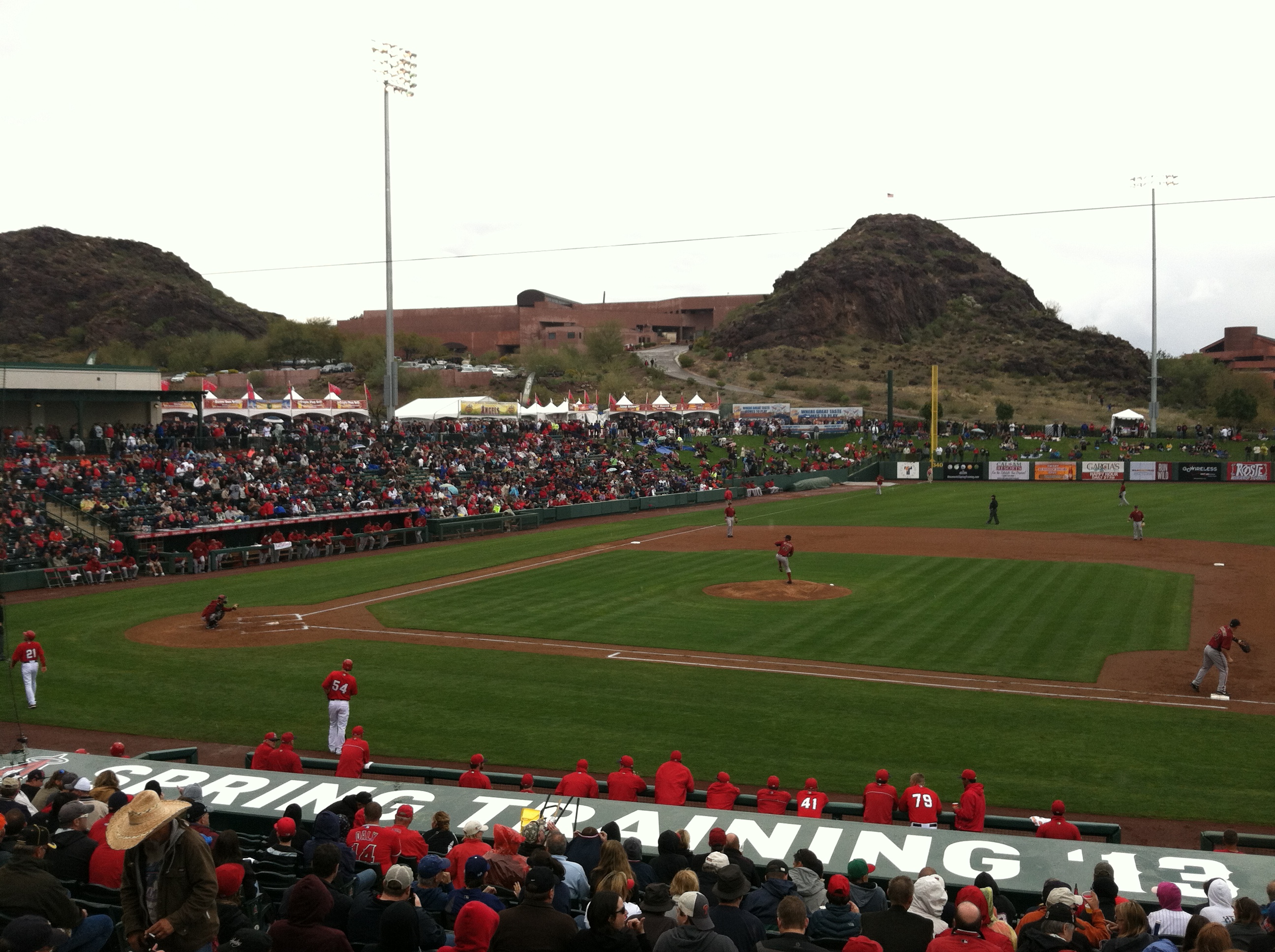
Hail - Tempe Diablo Stadium

Hail – Tempe Diablo Stadium

That facility was notable since it was the only stadium in greater Phoenix where I witnessed a game back on ’09. I had a few others on my itinerary but an errant check engine light and a broken fuel pump (don’t ever break down in Tuscon in July) put an end to my baseball plans in the Grand Canyon State that Summer. This time around, I planned on picking up where I left off. I had a World Baseball Classic, Coyotes, and Suns game, on the agenda as well as 8 spring training games on the slate and nothing was going to stop me, even if all I had was the shirt on my back. Absolutely nothing, not even a freak hailstorm.

Which is exactly what came during the third inning of the Angels game.

It may never rain in Southern California and it’s sunny 300 days a year in Arizona but sure enough, it was 50 degrees and hailing the day I landed. A few attempts to pull the tarp on and off the field was enough to frustrate the grounds crew as they gave up for good once the storm hit. It doesn’t get more bizarre than watching something frozen fall on a cactus but I had the pleasure of witnessing it firsthand within a few hours after touching down.

That night was the only game of the World Baseball Classic that I saw without getting kicked out of Chase Field and it didn’t go much better. R. A. Dickey finally met his match and so did anyone cheering on the red, white, and blue, as both were clearly outplayed and outdone by anyone wearing red, white, and green. I didn’t have the problem with my home team losing, I had just wished that the people cheering on the team they lost to moved here legally and didn’t get rottenly piss drunk during the game. There weren’t any fights that broke out (unlike their game against Canada the next day) but ask anyone in Arizona why the border has a 50 foot-high barbed wire wall along it and they’ll give you the straight dope on immigration there.

Sombrero - Chase Field

Sombrero – Chase Field

Slowly but surely, the weather improved over the next 5 days. Heck, it even started to feel like the summer. No yelling at passengers, grumbling over the latest run down Bushwick Ave., or griping about the $100 bill someone gave me on a $10 fare out there. Instead, it was tan lines on my feet, learning where the nearest Walmart and QT’s were, and scrambling across town to make the first pitch for the game that evening. I even had my old Ron Cey glove with me that I was given as a kid, as a reminder of the old man and how my family introduced me to the game that I couldn’t get away from. Like my skin, it was starting to look cracked, discolored in spots, and indicative of the years, but certainly felt as comfortable and reassuring as ever. There was nothing like watching the sun come out and give me something to look forward to, while taking me back to more innocent times.

I lost count of the instances in New York where someone asked me how I went to school and ended up schlepping them across town for a living. I would always give the usual spiel about the economy, my loans, and doing something that I loved to get me through the onslaught of factors that conspired to do me in. In reality, it was much more complex than that. Growing up in the shadow of the Big Apple made me yearn for something that I wanted to be a part of but didn’t have in my everyday life. Wanting to see the republic that the Greatest City in the World called home led me to drive across it numerous times, in my feeble attempt to be a modern-day Lewis and Clark or Kuralt.

And cabdriving fit both of those bills nicely.

New York City has over 6,000 miles of streets but over the course of my year and a half on the job as a hack, I’ve probably covered 10% of those. Because Manhattan is the primary turf for yellow cabs, much of the city remains as a frontier to me, even to this day. Just as anything west of the Delaware River was foreign to me until the mid-90’s, the City north of the Harlem River or east of the B.Q.E. still remains a wonderland to me, waiting to be explored and learned one fare at a time. The rest of America is still on that level for me as well, even though I’ve had my feet touch the Pacific Ocean more than once. Going through an area may open it up to my common knowledge but it takes a few repeat visits to get it down front and back and nowhere was that more apparent than when I made my way out west to watch my games.

Like New York, greater Phoenix is laid out on a grid…except that the one out there is more in tune with Southern California’s than the more famous one back east. Each major street was one mile away from the next one, resulting in a checkerboard pattern that still threatens to encompass everything in the valley out to Goodyear, Surprise, and Chandler. High gas prices and a housing market that still is drying off from its underwater sojourn were no match for the dynamo that has now made Phoenix America’s 5th-largest city, which was evident from the stakes in the ground on the outskirts of the valley.

In past years, I was only in one part of the country for a few days before leaving town on the edge of a given day and hurling myself to my next destination. This time around, it was different. I had one central point that I returned to every night and had to base everything off of it, which was not that much different than what my current job entailed. While no one would ever mistake downtown Phoenix for Midtown or the Financial District, there was something on the roads that reminded me of home.

Taxis.

Not one of them that I saw out there was yellow but they had a lot in common with the ones that I called home during working hours. Meters, sedans, and ubiquity were all found in the valley of the sun and even though I never had to hail one, I wasn’t too far from them either. That’s probably because I spent my free time at sporting events and late night spots, which is where they were to be found in a decentralized metropolis. I had no idea what the rates were but between them and the new light rail line that was put in, it was refreshing to see a city vastly different than New York take a cue from it in order to handle transportation for the working masses.

“Need a ride home?”

“No, thank you.”

“Have a nice day.”

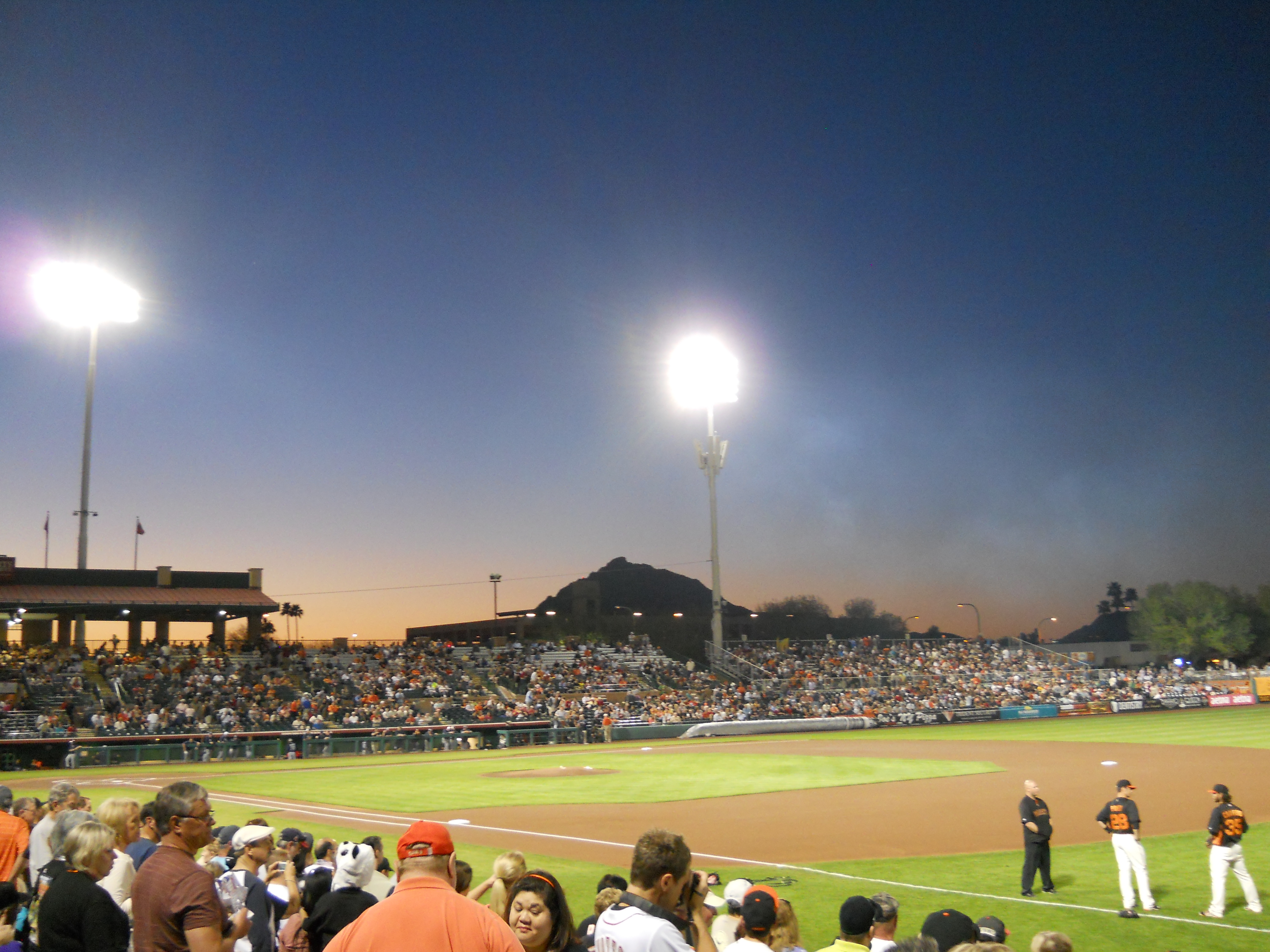
Sunset - Scottsdale Stadium

Sunset – Scottsdale Stadium

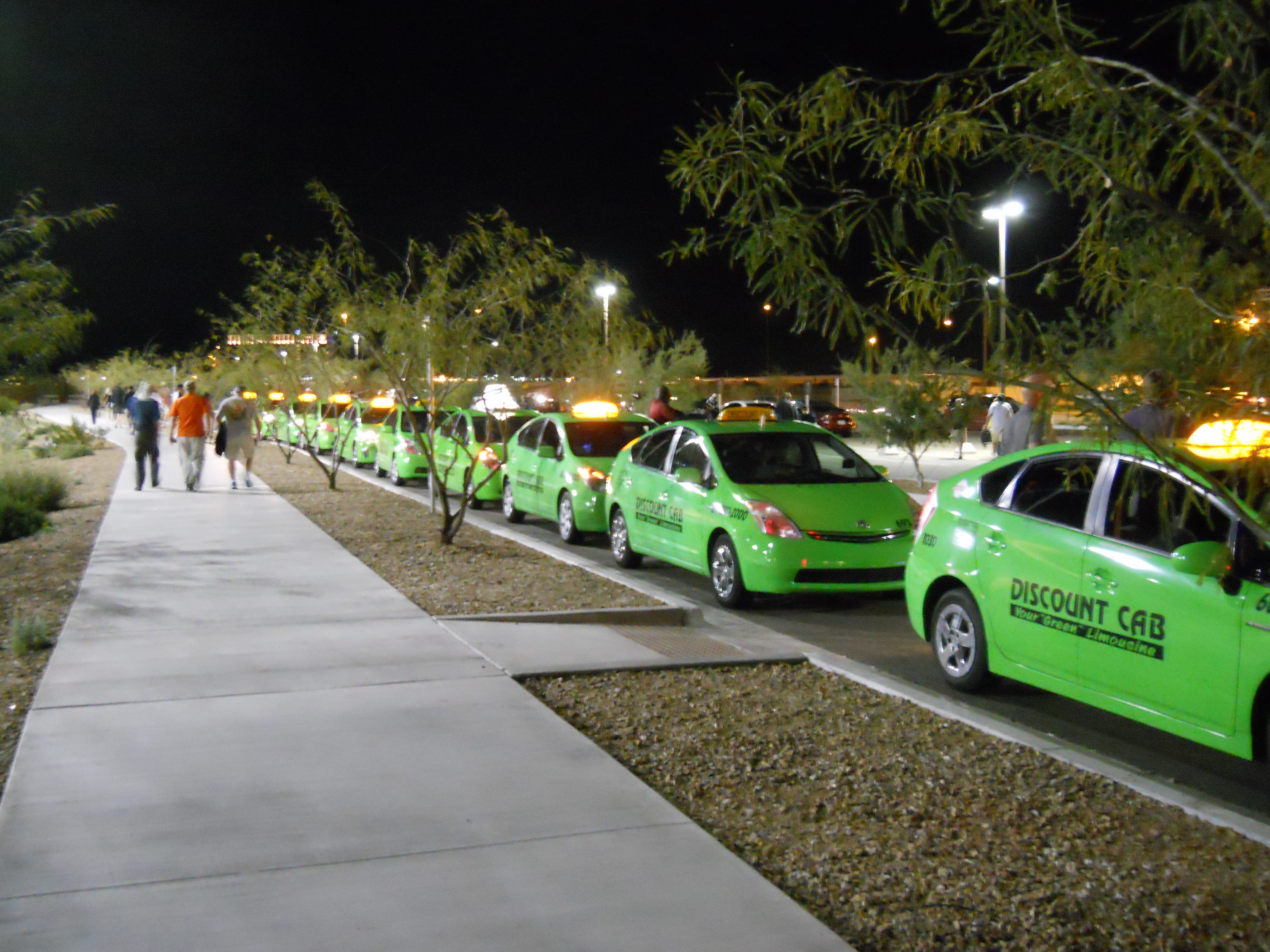
That turned out to be my only contact with an on-duty Taxi driver, during my night in Scottsdale. Most of the restaurants had stopped serving food once the Giants game let out for the night but that didn’t stop me from taking a walk through the downtown and soaking one on of the few pedestrian-friendly enclaves near the Cactus League parks. Most of them were set in relatively anonymous locales, near a major intersection marked by Gas Stations, chain drugstores, strip malls, and taco outlets. The only thing more bizarre than seeing these on the drags near the ballpark was passing the same 5 or 10 places on every major corner on the way home, with the occasional cab racing by me for good measure. On One the last full night I was in town, I chatted with a few cabbies that were in the line pictured below. I told them what I did and they responded by saying that they liked their jobs, knew where to go for fares, and also were able to take street hails and pre-arranged rides in their Taxis (something we need to solve back east). The Prius hybrids were good on gas too, which was a bonus given that prices were higher out west and the amount of distance covered in a shift could be quite cumbersome at times. As I made my way to my rental car after the Diamondback’s game, I took a little time to myself before calling it a night and packing to head home.

Loop 101 was right by the park and for anyone familiar with the Valley of the Sun, it’s the recently constructed highway that serves as the beltway for Phoenix. Parts of it went right through areas recently developed in anticipation of the highway but there were still pockets along it that went through sparsely developed blocks that hadn’t yet met the whirl and din of jackhammers and cranes. It was relatively close to the ballpark where I took my wheels and found one of these spots, parking the vehicle and going out for a stroll in the eerie calmness of a warm Arizona night. For a few minutes, I was able to see the stars, hear myself think, and resist the tide of overdevelopment that threatened to engulf everything in the middle of the state, right up to the edge of the mountains. It was at this time where I felt at peace with my current place in life, the trip I took, and what I had my life when it came to what I earned and who I had on my side. While it was only fleeting, it was something that I could always hold onto once I departed from the sunny days and disposition that I had enjoyed out west.

Especially when I had to trudge out to J.F.K. in the snow during my first shift after returning home.

Taxi queue - Salt Rive Flats

Taxi queue – Salt River Flats

How’d He Do?

For Hizzoner

For Hizzoner

When the 105th Mayor of New York City passed away earlier this month, it marked the end of an era. The New York of the late 20th Century was a city hemorrhaging jobs, prestige, and most of all, Capital. What had built up over the course of 300 years was nearly destroyed within a generation, due to suburbanization, concessions to unions, the expanding largesse of government, and corruption on all levels. All of it was not for naught, as it led to a rebirth of Gotham and it’s role relative to the rest of the United States and there was only one person who could spearhead this revival of the Big Apple.

Ed Koch.

Everyone has people that they admire in life and growing up, one of the ones that I looked up to was a sharp-witted man who rose up from his Greenwich Village Congressional District to run for Mayor 4 times, winning 3 of those contests with relative ease. For a kid reared in the suburbs who didn’t venture into New York much, it was part Oz, part Gotham, and part disaster area, and all of it a dynamic work-in-progress whose effects are still being analyzed and studied to this day.

Many baby boomers would say that John Lindsay was the best Mayor of their generation, since his election in 1965 marked the end of the Tammany Hall Political Machine’s stronghold on New York’s politics and the ushering in of a Progressive mindset that altered City Government and brought new ideas to the table. For sure, the City did change. Transit fares skyrocketed, Teachers went on strike in Ocean Hill and Brownsville, Social Programs escalated with backing from The Great Society, Crime went through the roof, Unions strengthened their hold, and whole neighborhoods were remade in a generation. What little progress was made with the redistribution and reallocation of wealth was more than offset by deferred maintenance, crumbling infrastructure, unplowed streets, and increased borrowing to meet fiscal needs. All of that came to an abrupt end in 1975 when President Ford effectively told the city to drop dead.

Thankfully, it didn’t.

Two years later, it hit rock bottom. Large parts of Brooklyn were decimated during the blackout that year, Son of Sam kept everyone in at night, and Howard Cosell told everyone watching the Yankees in the World Series that indeed, “The Bronx was burning.” What people couldn’t see then was that New Yorkers had had enough of higher taxes, worsening services, a hollowing out of the business cores, and disdain from the outside world at what had once been the World’s Greatest City. All of this led was borne on the shoulders of one man, who took on the Herculean task of bringing New York back from the Brink.

To be fair, it wasn’t easy. Taxes didn’t drop off overnight, the West Side Highway and East River Bridges took years to rebuild, much of the city’s housing stock had to be razed, handed over to private developers, and rebuilt, and there were problems such as the Crack Epidemic, and still-esclating murder rate to deal with. The biggest difference between those problems and those of a generation earlier came in 1980. Once again, the Transport Worker’s Union went on strike just like they did 15 years earlier but instead of the Mayor lacking a backbone when dealing with the situation, Koch stood on the Manhattan end of the Brooklyn Bridge and greeted New Yorkers who braved the elements and made the walk to work. As always, he asked them one simple question.

“How’m I doing?”

For someone who did so much to alter the course of the City’s History, he did not get a fair chance to go out on his own terms. Bess Meyerson, corruption, and the annoyance of Jesse Jackson led to his losing of the 1989 Mayoral Primary to then-Manhattan Borough President David Dinkins, who went on to become the first African-American Mayor of New York. It would have been interesting to see how Koch would have handled the riots in Crown Heights or the Police Uprising at City Hall in 1993, which along with the recession of the late-80’s and early-’90’s, ended up to Dinkins’ demise after only one term.

when I was growing up, I used to read anything that I was interested in and could get my hands on. Without an internet or a car of my own, that was how I found out about the world around me and what I wanted to see once I was able to get out onto my own. Every time I’d go to the library, I’d take out a giant stack of books and hold onto them until their due date, often paying fines because I had forgotten about them or wished that I could have them for just a little while longer. One of my favorite books was Manhattan – An Island in Focus By Jake Rajs. All of the shots in there were taken from the late-70’s to the mid-80’s and with the full color, oversized pages of it, reminded me of what the city was emerging out of what it was going to become for the generations ahead. Interwoven with the pictures was a quote from none other than Koch himself:

“New Yorkers walk faster, talk faster, and think faster. You don’t have to born here to be a New Yorker. But after six months here, you’ll be walking faster, talking faster, and thinking faster. At that point, you will have become a New Yorker.”

This, coming from a man like me who was reared in the Garden State.

As I drove around the city during my shifts in the weeks after his death, I kept asking myself what was his legacy and where could I find it. One day, it hit me – the city of today *is* his legacy. All those abandoned and condemned buildings? Torn down or rebuilt, as the city has much better housing stock today than at any time in generations? Those crumbling highways and bridges? Rebuilt, heavily used, and soon to be joined by a new water tunnel, riverfront park system, and rail extensions that will serve millions every day. The city’s finances? While taxes are still high, New York hasn’t come close to being broke since the MAC was implemented over 35 years ago. Cranes dotted the sky in the 80’s and they are again today all over the city, and not just in Manhattan.

Perhaps his greatest legacy was seen by all at his service. People of every color and nearly every corner of the World went to pay their respects for him on the East Side. Many of the Mayoral Candidates were there too, and it serves as a testament to him that the possibility of another African-American, an Asian-American, or even a woman may be running the city come next January. It was once inconceivable that someone who went to CCNY could be elected to the highest position of City Government but now, a diverse set of candidates seeks to lead New York into the future.

What it all boiled down to for most was that yes, Koch was just as known for his witty nature, his stint on The People’s Court, countering his party with his staunch support of Israel’s right to exist and defend itself, and his relentless drive to clean up Albany as he was for his work as Congressman and Mayor, because it had been over 20 years since he last served elected office. Ask anyone who knew of him or met him and although he could have been a bit abrasive at times and spoke his mind, they’d all say the same thing about him:

He did well.

iPhone22 043

Blue and orange, in memoriam

Brooklyn’s Finest

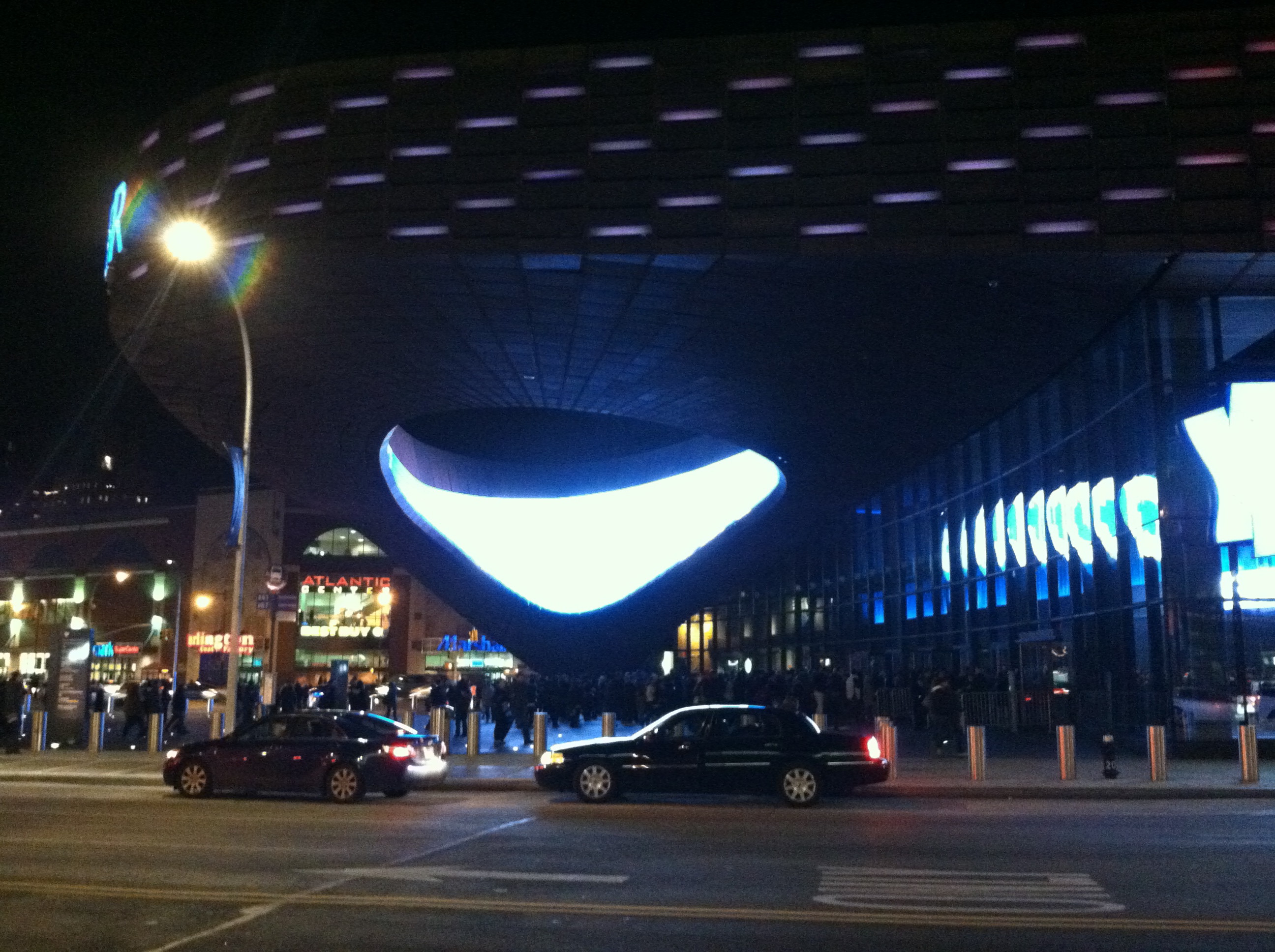
The Oculus - Barclays Center

The Oculus – Barclays Center

“I can’t stand it.”

As I made my way down Flatbush Ave. time and time again, I asked anyone and everyone that I was taking home to Brooklyn what they thought of the building pictured above, as it was under construction. Doctors, teachers, parents, artists, office workers, waiters – nearly all of them had an opinion on it and it wasn’t good. They were afraid of the crowds, traffic, loss of character in neighborhood, and the rise in property values. With much fanfare last fall, the Barclays Center finally opened and the long-awaited redevelopment of the Long Island Railroad yards finally had some concrete results that people could see and judge for themselves. Of course, I was one of them since I attended one of Coldplay’s concerts there right before New Year’s.

I’m not a huge fan of stadiums and arenas from an economic development standpoint. As much as I love my sports teams and the facilities they play in, it’s more of an aesthetic and design standpoint that I judge them from, and not whether they can bring a neighborhood back from a decline. As any New Yorker could attest to, the centerpiece of the greater project known as Atlantic Yards was more than just an arena for an NBA team. It was supposed to be a Frank Gehry-designed sports facility with loads of housing behind it and a skyscraper that would have been dubbed “Miss Brooklyn”, since it would have been the tallest in the Borough once completed. Most of those plans were scrapped in favor of the arena that SHoP ended up designing (to rave reviews) while the housing is still in limbo. What the final appearance of the yards will be remains anyone’s guess but the site already had a story that could be seen underneath the LED lights and exterior.

For starters, there’s been a huge re-branding of the team that formerly resided in my home state. It shouldn’t come as any surprise that their primary color was chosen to be black since it’s a timeless color that doesn’t go out of style. The concourses and seats inside were this hue as well, leading me to believe that it was a done deal long before the team announced their new name and color scheme. Along with that was a huge proclamation that professional sports had returned to New York’s most populous Borough, long after the Dodgers had bolted for the West Coast half a century earlier and left Brooklyn without its own team to root for. Unfortunately, pro sports *had* returned to the Borough a few years earlier, just not at the Major League Level.

The irony of the Nets rechristening as “Brooklyn” was the tale of the Dodgers and how they left the East Coast in the first place. Nearly everyone knows that Walter O’ Malley wanted a new Stadium for his team to replace the aging Ebbets Field. Robert Moses, who controlled nearly every City and State development agency in New York in the late 1950’s had a site ready for him…but it was in Queens. O’ Malley nixed the idea, packed up everything, and the following season, the Dodgers were playing their games in Wrigley Field (no, not that one in Chicago) before Dodger Stadium opened in 1962. Two years later, the expansion Metropolitans moved into a facility on the same Queens property that Moses had envisioned for “Dem Bums” and by then, there was a whole world of excitement next door with the World’s Fair going on in Flushing Meadows Park.

What many don’t know is that none of this would have happened had O’ Malley had his way. As hated as he remains to this day, he wanted to keep the team in Brooklyn. His goal was to have a concrete, state-of-the-art Stadium built right in the heart of the Borough, on the largest undeveloped parcel that remained in Brooklyn. The team would have only moved a little over a mile away, the Dodgers would have stayed in New York, and maybe Horace Stoneham would have sought a simliar replacement for the Polo Grounds. The new field would have been built on top of the railyards just beyond the corner of Flatbush and Atlantic Avenues…

…which is precisely where the Barclays center opened 55 years later.

This isn’t a lesson on how the blackmailing of cities over sports venues can come full circle but rather, one in urban planning. Much like the MTA yards on the West Side of Manhattan, Atlantic Yards in Brooklyn represents the aspirations of a place looking to move into the future on one of the last blank slates in its cityscape. Cultural attractions, improved mass transit connections, housing, parkland, and open space are seen as the magnets that will draw the professional and affluent residents that 21st Century Cities will need in order to survive and maintain the tax base. Naturally, someone will end up being displaced and dismayed at the whole environmental and review process, which will ultimately turn out to be the residents and drivers (including yours truly) when all it said and done. Much of the traffic patterns around the new Arena were screwed up for months during the construction of it, which had to be done on time for the Jay-Z concert that marked its opening. There still isn’t anywhere good for Yellow drop-offs and pickups, although the black cars have their own space for those functions. After all, Brooklyn is an Outer Borough!

The locals who decried the monstrosity that arose over the railyards have no choice but to live with it now, and the high rises that are planned to go on the back side of it. Even if the entire project was cancelled, the wave of development that has crept over the Lower East River Bridges and settled in Downtown and Boerum Hill has already changed the appearance of the Borough forever. Rents are closer than ever to those in Manhattan and more people are commuting within Brooklyn now for work than ever before. As evidenced by the high ticket prices and cost of concessions at the Barclays Center, it’s not the only way that Manhattan has reared its ugly head in the former “Outer Borough”.

As I’ve said before, a cabdriver told me once that when he used to drive people to Brooklyn, cops would tell him where Manhattan was and how to get back there since they thought he was lost. That’s no longer the case and as more people want to call the Borough home, the onslaught of high-end apartment towers, chain stores, and cultural amenities geared towards the rich will only continue to proliferate. Even though the Barclays Center is largely clad in weathered steel designed to invoke the surrounding industrial past, there’s no doubt that the building on the corner of Flatbush and Atlantic Avenues is from the future, and a harbinger of more change yet to come.

Barclays Center from across Flatbush Ave

Barclays Center from across Flatbush Ave

Raise the roof light

A typical weekend cherry-picker

A typical weekend cherry-picker

“So let me ask you something…”

“Yeah?”

“What’s the deal with the roof lights? Seems like half of the Taxis are off-duty right now but it’s Saturday night.”

“Well, not this cab. I don’t play that game and any cab driver worth his salt won’t have the off-duty lights on unless he’s legitimately going on break.”

I can’t even begin to describe how many times I’ve had this conversation or something similar to this since I started driving. One of the things we went through in Taxi school how was to go off duty, which involved three steps:

1) Lock the doors

2) Put the off-duty lights on

3) Log off and go take your break for as long as need be

Want to guess how many drivers actually do this? If I had to guess, I’d say that very few actually go by the rules like we’re supposed to. One of the perks of my job is that I can take a break whenever I wish, as long as my vehicle doesn’t have any passengers in it. It’s not something I do often but when nature or hunger pangs call, no one tells me to “get back to work” or to wait until a designated break time.

The big problem with the off-duty lights as currently construed is that it is *not* linked to the computer/gps that we have to log into before the start of a shift. What that means is that drivers can be on-duty with the off-duty lights on, with the ability to abuse the pickup of passengers via cherry-picking. Among all of the changes that the yellow cab industry will be undergoing in the next few years is an overhaul of this roof light system. In an ideal world, the lights would be gone and replaced with nice, bright LED green and red bulbs. The former would be for any cab available and the latter would cover cabs that would be occupied, off-duty, mechanically disabled, and so on.

Until then, the antiquated lights remain. For anyone unfamiliar with the way cabdrivers use them now, here’s a 101 on how to read them the next time you’re in the Big Apple:

1) Center light on, off-duty lights off: Cab is empty and read to take a fare. Hail away!

2) Center light off, off-duty lights off. Cab is occupied with a passenger.

3) Center light on, off-duty lights on: Cabdriver is most likely cherry-picking. God forbid you’re going to an outer Borough or to a place that the driver doesn’t want to take you to. You’re about to get an excuse from the driver that reeks of B.S., but you the passenger will be the one shoveling it once the Taxi speeds away.

4) Center light off, off-duty lights on: Cabdriver has taken a passenger to a spot that is more than likely within Manhattan or to a spot where the driver thinks he can “flip” (find another fare after discharging the passenger) the fare quickly.

Yes, it’s illegal to ride around cruising while keeping the off-duty lights on but if TLC got a complaint every time this happened, 311 would crash almost instantly. Keep in mind that the only time we’re supposed to ride around like in Option 3 is a half hour before the end of our shift, when the Taxi is on its way back to the garage and must be there at a designated time for the shift change. Lucky New Yorkers who live in Astoria, Long Island City, or Sunnyside can always get a ride across the Queensboro Bridge at 4:30 since hordes of yellow cabs are making their way back to their respective garages before the rush does them in.

I don’t worry about the changes coming – smartphone apps, outer Borough Taxis, the Taxi of the Future, or the new rooflights. Drivers who don’t own the medallions aren’t tied down to the vehicles and we have enough outlets to vent the problems that exist in our industry. If anything, Taxis need to change with the world around them and if it has to start with the way that passengers see and hail us, so be it. I just wish that all of these improvements would have more input from the people who actually make the system run instead of those who control the strings from above.

Suburban War

Olive Garden - Chelsea

Olive Garden – Chelsea

One of the perks of being a cabdriver is getting to meet people from all over who come to the Big Apple to visit friends, family, and of course, relax. From New Jersey to New Zealand, there’s hardly a country or corner of the Earth that hasn’t sent at least one person my way since I started driving for a living. Being that most of these people are unfamiliar with the city, I get asked a lot of questions, with one of the most common being one of the simplest as well:

“Where should we go eat tonight?”

I don’t mind answering this one even though my time spent imbibing is usually at Gray’s Papaya or from something on four wheels. What I read about and have tried in the past will go into any answer that I give along with one simple caveat:

“You better not eat at the Olive Garden – that’s not why you came to the Big Apple.”

Sure enough, I have to drive up 6 Ave. practically every shift to cruise for fares or to get people uptown and there hasn’t been a shift where I didn’t cringed just a wee bit when I went past the neon sign shown above. To add insult to injury, it’s on the same block as a Cosi and just a stone’s throw from Home Depot and Best Buy.

The running joke in New York now is how everything is located near a Starbucks, Duane Reade or Chase but lost in the shuffle is the fact that you’re more likely today to run into a Subway restaurant than an actual Subway station in Manhattan and that cannibalization no longer refers to an eating practice but for individual units in a franchise that are competing with each other instead of the competition. Indeed, the first TGIFriday’s was an actual singles bar that opened on the Upper East Side in 1965 but when you hear that name now, only place comes to mind as it’s natural location:

The Suburbs.

Most people reading this don’t know it but indeed, that’s where I grew up and still call home to this day. Suburbia was once the urban hinterlands of America but later took on an identity of its own when it became the home of these chains, along with tract housing, single-use developments, and loads of commercial buildings that popped up in the decades following V-E Day. Most importantly, it was the site of much of the growth in America in the middle of the 20th century and the final  destination of  those fleeing older urban areas during the years of forced integration and racial strife; helping to coin the term “white flight”. What current demographers are noticing now has been a reversal of that trend and nowhere is this more evident than in the Big Apple.

While much of the Outer Boroughs and edges of Manhattan fell into disarray during the decades of demographic upheaval, old industrial areas like SoHo were the first neighborhoods that underwent gentrification. Cast-iron industrial buildings that were abandoned due to an economy that was moving in a postindustrial direction were taken over by artists, LGBT’s, and squatters. New restaurants and shops followed as as rents increased, these urban homesteaders were forced out in search of cheaper pastures in which they could set up their wares, and the cycle repeated. Chelsea, TriBeCa, the Upper West Side, and other nether regions of Manhattan saw this process repeat itself but in the 21st century, there have been some changes to this pattern that are still worth noting.

The primary difference today is where these changes are taking place. Much of the Outer Boroughs that resembled war zones are now the sites of these latest rounds of gentrification from the ground-up. Long Island City, Williamsburg, “The Hub” in the South Bronx, and Bushwick are wthe ground zeros that the artistically hip and cutting-edge of young society are now setting up shop. Whether the ripples will radiate all the way out to East New York and Co-Op City remains to be seen but the edge of the “City” of New York still remains fluid even though the borders of the 5 Boroughs have been fixed for over a century now.

Second are the types of dwellings that the new residents are calling home. While adaptive re-use is still the preferred mode of redevelopment, glistening new towers on the waterfront or around transit hubs like Jamaica have shown that all new construction need not be confined to the Island of Manhattan. Land prices have risen so much that any site can be prime for redevelopment as long as zoning allows for the right type of building to allow for a return on investment. The Citi Tower in Long Island City was all alone for nearly 20 years but threatens to sit in a field of moderately-sized developments on the drawing board. Manhattan will still be the heart of Gotham when all is said and done but there were be pockets of developments that will rival the main island in terms of density and cutting-edge high-rise design.

Third are the types of retail developments that accompany the boom in housing. As a cabdriver, there’s very little as strange a seeing Toys R Us, Kohl’s, and Wendy’s in a suburban-style big-box development while taking a passenger down the Belt Parkway out to Coney Island or Manhattan Beach. I’ve lived within a stone’s throw from all of those for years, with all of them easily found on the local “strip” that could also exist on any 4-lane highway in America and conveniently, those 3 are within a mile proximity of each other, on my way to the Big Apple. Which brings me to my fourth point and the reason why I felt compelled to write this post…

Of course, that would be the trust fund babies that are populating much of the new growth in New York. Right now, nothing hurts me more than seeing how much money I owe the banks and the folks in Washington for the education that I worked for at Columbia. Time and time again, I hear passenger’s conversations about how unaffordable the rents are in New York and where everyone is going to go next, if they even want to stay in New York. One look at the glass-walled buildings and the neighborhoods they stick out of always brings a sneer as they discuss how the people that occupy them are living of their parents money while they shop at vintage clothing stores and take over parks and public spaces in Manhattan under the guise of bringing the 1% down. People in the ’60’s and 70’s were protesting old money, wealth, and the establishment while living in buildings that may have lacked heat, plumbing, or even permits. These days, everything comes complete with three month’s deposit along with access to the roof deck. Pushing the edge was never so easy since the new neighborhood was so much like the one back at home that would now be left behind. What better way to remind one of the old life left behind than to bring the familiarity and comfort of the ubiquitous chain with them?

As I have said time and time again, the New York that I grew up with in the 80’s has been relegated to pile of old photographs (remember those?) and books that I have up in my attic. Once in a while, I will pull them out and reminisce at how the city and its inhabitants used to look. While change is inevitable and a sign that the city is still economically viable and healthy, I wish that so much I loved about those days was still around with me today. While my Taxi will no longer be washed on the way to Yankee Stadium while waiting at a red light or will have to dodge the rotting pillars of the defunct West Side Highway, it would love to come across an automat, a vinyl record store, a NYNEX truck, or a three-card monte player. Instead, it’s more likely to come across a Target, Applebee’s, IHOP, or Walmart, even though the latter has yet to open within the city limits. Most importantly, I’d like the ride that I take during work to be quite different than the one I take during my rare off-night here in Jersey. While I can’t guarantee that my life’s path will ever see me reside in the Big Apple, I do hope that city won’t sell its soul in an attempt to appeal to everyone who wishes to live there. Chains are everywhere but there will only be one place good enough to be nicknamed Gotham and the day it becomes just like everywhere else is the day that moniker needs to be retired; for at that point, the city will no longer deserve to stand out amongst its peers.

Looking north to yet another Subway - Williamsburg

Looking north to yet another Subway – Williamsburg

The Tenderloin

Checker Cab and newlyweds

“Hey there, where to?”

“9 Ave. and 13 St.”

“Are ya going to catch?”

“Yeah, how did you know?”

“I’m a cabdriver, we should know where the hotspots are. It’s new and a pretty popular club but I have yet to get inside of it.”

Without a doubt, there is no other neighborhood in Manhattan right now that polarizes New Yorkers like the Meatpacking District. Fashionistas and those with money flock to it, tourists put it on their must-see list when visiting town, and locals shun it like the plague. Times Square may evoke similar love/hate feelings but the Crossroads of the World hasn’t changed a whole lot since the last of the “Times Towers” were completed in the middle of the last decade.

The area where 9 Ave. dissolves into a jumble of cobblestone-laden rues is another story altogether. At one time, Meatpacking was a moniker that the neighborhood deserved. Old-style loft buildings with loading docks were home to processing plants that handled much of the beef that the Big Apple consumed. So many trucks rumbled through the streets that the highway and rail line that ran through the West Side were elevated to avoid the numerous grade-crossing conflicts that arose each day. No one wanted to live, work, or eat in an open-air slaughterhouse that was the east coast’s version of The Jungle and the only signs of life at night were those of the LGBT persuasion that roamed the streets looking to turn tricks.

Like so many instances of my youth, one of my biggest regrets was that I was not able to photograph the area when I first made my way through it alone in the mid-90’s. What would have shown up on the images were old buildings long past their prime, a giant Western Beef depot, empty streets, an occasional rumbling truck, and the old diners that served those who held the blue-collar jobs that were rapidly fading from the cityscape. It was a wonderland for those intrepid enough to make the trek down there, but not terribly exciting for those looking to pass the day in the neighborhood.

Nothing could be further from the truth now. Like so much of New York, Postindustrialization has taken root there and flourished to the point where the mere mentioning of the neighborhood in conversation now elicits snickers. At the heart of this lies none other than Ganesvoort Street and while it’s not terribly long when it comes to venues on the Manhattan Street grid, it is the epitome of the infrastructural change and stasis that characterizes Gotham today. Both ends of it were sites of massive projects that altered the lives of nearly every New Yorker with the east end block off for a Water Tunnel #3 shaft and the west end the site of the collapse that spelled the untimely end of the West Side Highway. In between are much of the things that characterize the district as we know it today: The construction of the new Whitney Museum, the shuttered remains of Florent, the clubs all in a row, and a cobblestone street to link them all together. None of the buildings were in the same state 10 years ago and it’s anyone’s guess what they’ll be a decade from now but given how high rents are climbing, it’s unlikely that the stasis will take effect and turn the neighborhood into a living museum that will serve as a reminder of how the uber-rich partied in the late 2000’s and ’10’s.

In the middle of this runs the highly-praised High Line, which many have lauded as the catalyst for the neighborhood. While the change would have taken place with or without it, it has been a gigantic draw for locals, tourists, and architects alike. 30 years after the last trainload of frozen turkeys rumbled on it, it was reborn as an Urban Park modeled after one in Paris, for the enjoyment of all. What many New Yorkers are unaware of is that it used to continue south of its current terminus, having been quietly torn down years before the remaining section was reborn as an elevated promenade. Like the Highway a block to the west, decay had taken its toll in a era where destruction was the conventional wisdom. Today, the thought of eliminating a right-of-way that valuable would be met with outcry, if for no other reason than preserving it as a transit route in a city that desperately needs more. Whether the High Line was reused properly will be the subject of debate far into the future but one thing for sure is that it has been a success, largely due to the integration into the buildings and streetscape of Far West Side and not the avoidance of it like in its previous incarnation.

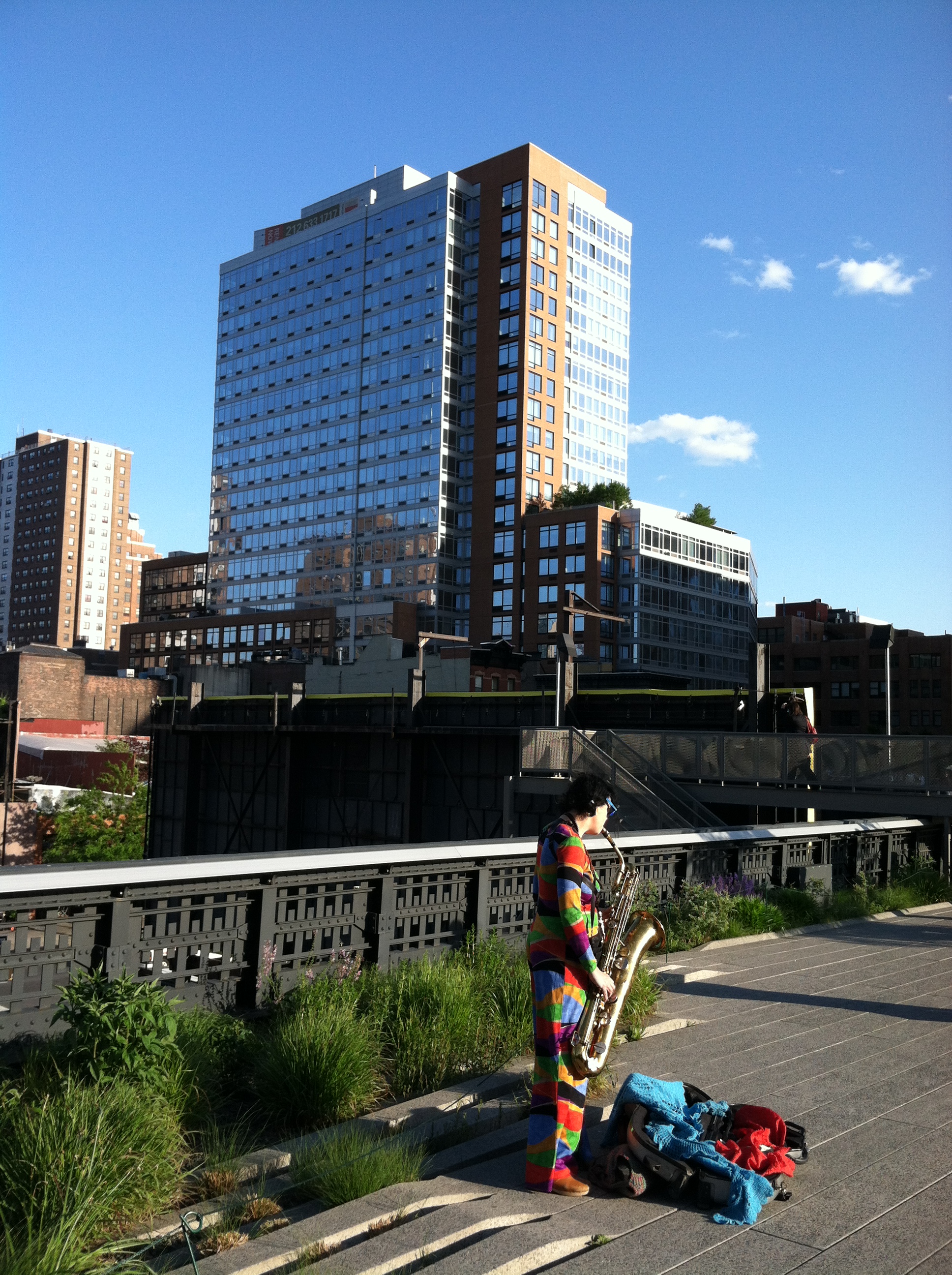
Colorful bari sax player – High Line

As some retailers move out and other areas of the city that are cheap continue to gentrify, the Meatpacking District may see a day where it’s not a “hot spot” anymore. Given how many times I drop off and pick up down there, I don’t see that happening anytime soon. Much of the city’s next hotel boom will oddly be on the Lower East Side and if zoning was ever changed, that could be fashionista central within a few years. Even the old Essex Street Trolley Terminal under Delancey Street could be reinvented as the “Low Line” – the next urban relic reinvented for a city that glorifies and commodifies the past, in the form of public-private partnerships. For now, that remains to be seen whether the trendiness of the West Side will migrate eat and reinvent a neighborhood that bridges Hipsterville with the rest of Manhattan.

“Here you go.”

“Thanks Pat.”

“Not problem. You missed it at the bar – I ended up eating the snacks that they left out on it because I thought they were for everyone seated there. Apparently they weren’t, as the people next to me gave me a look as I snuck one in.”

“Really?”

“Yeah. I had to have one since it took so long to get our drinks. This place reminds me so much of a casino even though I haven’t been in one in years.”

“It is pretty nice in here.”

“This is one of the most beautiful places in the city, just like what I heard. Such a 70’s look to it but I don’t see it getting outdated anytime soon. I know things cost a fortune in here but this was worth it. How’s your drink?”

“Good, yours?”

“It’s wonderful, but anything with Saint Germain is. Want to try some?”

“Sure.”

“You know, it’s funny. I take people through right by this hotel all the time and now it’s so odd seeing it from up here. Everything looks so small and so distant. I can see why they call this the Boom Boom room. I’m glad you’re here with me to take it in.”

“It’s nice to be with you too Pat.”

The woman I was with that night is no longer in my life but just like out time on top of the Standard, I’ll cherish our time together. It’s always nice to reminisce, even if I’m not meant to live the high life right now.

The view from the Standard

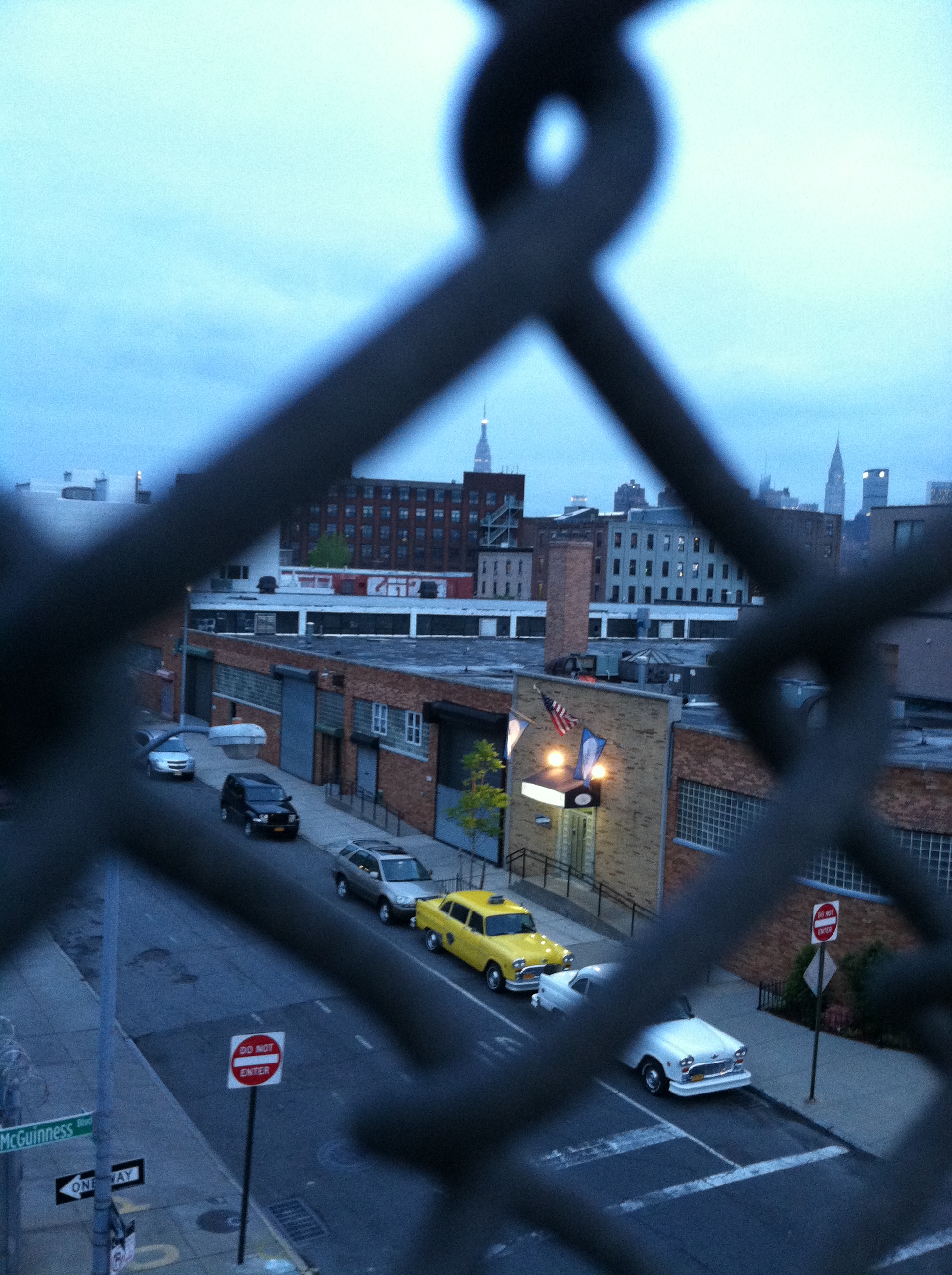
A checkered past

Checker Cab – Greenpoint

The fare hike that went into effect last week came and went without a lot of fanfare. Much was written about it over the summer when it was debated at a series of TLC meetings but many New Yorkers thought that those in my profession were due for a raise that was a long time coming. The big debate was not how much to raise the fare but what percentage of it would ultimately end up in the driver’s pockets and not in the hands of the medallion owners and garage operators. Lost amidst the hubbub of the hike and the throngs of groggy commuters returning to work this week was the other change that coincided with the new rates – that being the new logo on the side of the Taxicabs themselves.

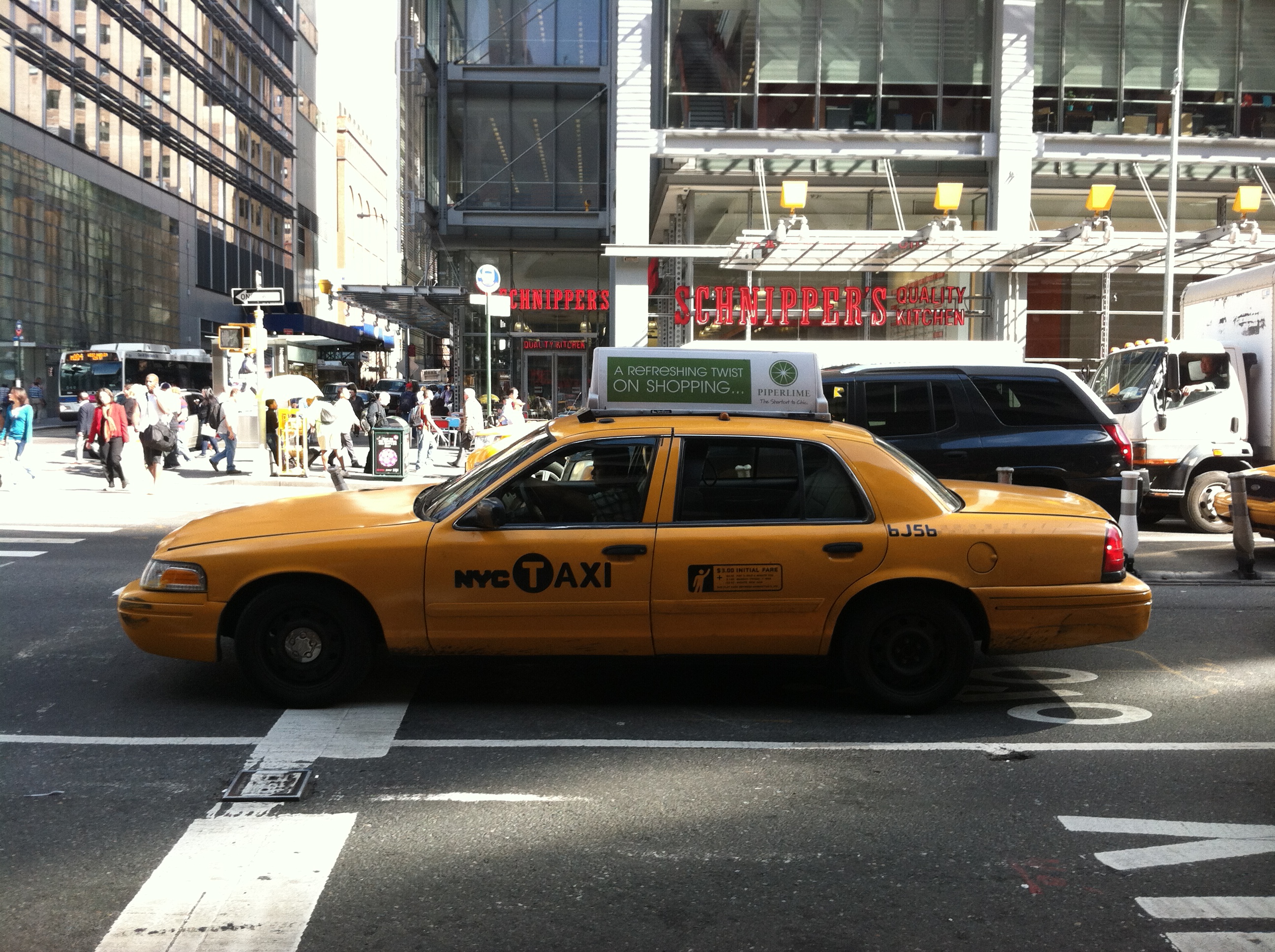
The old Taxi look

For the last few years, all of the Taxis in New York had the look seen above, with the “NYC” in the official font next to the Taxi logo on the front door and the rate chart on the back door. On the back of cab was the strip as I call it – the checkerboard pattern that was found on cabs back when an actual company called Checker supplied the cars that roamed the city streets. As the models where replaced and the company went out of business, the pattern became smaller and smaller over the years, until it was finally relegated to just a tiny reminder of the way things used to be.

Until the fare went up last week.

The new Taxi look

This is how your ride in a yellow cab will now look on the outside. The “NYC” that was so prominent has been shrunken down, the fare chart has been simplified to two symbols, and the work “Taxi” has been replaced by a big, black “T”. The thinking behind it is that New Yorkers, and visitors, should know what a yellow vehicle that doesn’t carry kids around all day should function as, so why bother labeling it as such? All of the marketing wizards could do was come up with this but I guarantee that a bunch of us who actually drive the vehicles all day could design something just as informative and not charge the city an arm and a leg for it in the process.

What bothers me the most is what’s on the back and that would be nothing. Like the automat , the subway token, and the old “Walk/Don’t Walk” signs, the checker pattern on a Taxi has now been relegated to the dustbin of Gotham’s past. In order for the Taxis to charge the higher rates, the exterior had to be changed along with the upgrades to the meters. A few of the cabs this past week still sported the old design, which only had one advantage: Smart New Yorkers knew that they were charging the old rates and would hail them instead of a upgraded Taxi. This won’t go on for long but given how expensive everything is today, I had a few people tell me that they were attempting to do that when looking for a ride.

Economics aside, the new design marked another indication of the homogenization and globalization of New York. Pictures and symbols continue to expand as more people from around the World continue to visit the Big Apple. The less English they have to come across, the easier they can get around. Soon, the subway will be fully automated, Street signs will get bigger than they are now, and smartphone apps will ensure that no one will ever get lost again when navigating the city. It’s bad enough that the cabs have maps, GPS’s, and endless commercials on the backseat screen, all in the name of progress. If nothing else, a Taxi should say what it is, let anyone think that a black car has the same role that a yellow one does on the city streets.

Soon, the Crown Victorias, SUV’s, and Prius’s will all be scrapped in favor of the NV200, a.k.a. the Taxi of the Future. What seemed so common today will be old hat in the coming decades as change will inevitably take hold and thrust all of us into the future. These “upgrades” will be fully present in a new fleet that will be more environmentally friendly, accessible, and better designed, but the real shame in it will be in the scrapping of what made Taxis so beloved in the past. As all of this takes hold in the next few years, one question never seemed to cross the minds of the designers:

Would it have hurt to keep the checkerboard pattern as it was?