Suburban War

Olive Garden - Chelsea

Olive Garden – Chelsea

One of the perks of being a cabdriver is getting to meet people from all over who come to the Big Apple to visit friends, family, and of course, relax. From New Jersey to New Zealand, there’s hardly a country or corner of the Earth that hasn’t sent at least one person my way since I started driving for a living. Being that most of these people are unfamiliar with the city, I get asked a lot of questions, with one of the most common being one of the simplest as well:

“Where should we go eat tonight?”

I don’t mind answering this one even though my time spent imbibing is usually at Gray’s Papaya or from something on four wheels. What I read about and have tried in the past will go into any answer that I give along with one simple caveat:

“You better not eat at the Olive Garden – that’s not why you came to the Big Apple.”

Sure enough, I have to drive up 6 Ave. practically every shift to cruise for fares or to get people uptown and there hasn’t been a shift where I didn’t cringed just a wee bit when I went past the neon sign shown above. To add insult to injury, it’s on the same block as a Cosi and just a stone’s throw from Home Depot and Best Buy.

The running joke in New York now is how everything is located near a Starbucks, Duane Reade or Chase but lost in the shuffle is the fact that you’re more likely today to run into a Subway restaurant than an actual Subway station in Manhattan and that cannibalization no longer refers to an eating practice but for individual units in a franchise that are competing with each other instead of the competition. Indeed, the first TGIFriday’s was an actual singles bar that opened on the Upper East Side in 1965 but when you hear that name now, only place comes to mind as it’s natural location:

The Suburbs.

Most people reading this don’t know it but indeed, that’s where I grew up and still call home to this day. Suburbia was once the urban hinterlands of America but later took on an identity of its own when it became the home of these chains, along with tract housing, single-use developments, and loads of commercial buildings that popped up in the decades following V-E Day. Most importantly, it was the site of much of the growth in America in the middle of the 20th century and the final  destination of  those fleeing older urban areas during the years of forced integration and racial strife; helping to coin the term “white flight”. What current demographers are noticing now has been a reversal of that trend and nowhere is this more evident than in the Big Apple.

While much of the Outer Boroughs and edges of Manhattan fell into disarray during the decades of demographic upheaval, old industrial areas like SoHo were the first neighborhoods that underwent gentrification. Cast-iron industrial buildings that were abandoned due to an economy that was moving in a postindustrial direction were taken over by artists, LGBT’s, and squatters. New restaurants and shops followed as as rents increased, these urban homesteaders were forced out in search of cheaper pastures in which they could set up their wares, and the cycle repeated. Chelsea, TriBeCa, the Upper West Side, and other nether regions of Manhattan saw this process repeat itself but in the 21st century, there have been some changes to this pattern that are still worth noting.

The primary difference today is where these changes are taking place. Much of the Outer Boroughs that resembled war zones are now the sites of these latest rounds of gentrification from the ground-up. Long Island City, Williamsburg, “The Hub” in the South Bronx, and Bushwick are wthe ground zeros that the artistically hip and cutting-edge of young society are now setting up shop. Whether the ripples will radiate all the way out to East New York and Co-Op City remains to be seen but the edge of the “City” of New York still remains fluid even though the borders of the 5 Boroughs have been fixed for over a century now.

Second are the types of dwellings that the new residents are calling home. While adaptive re-use is still the preferred mode of redevelopment, glistening new towers on the waterfront or around transit hubs like Jamaica have shown that all new construction need not be confined to the Island of Manhattan. Land prices have risen so much that any site can be prime for redevelopment as long as zoning allows for the right type of building to allow for a return on investment. The Citi Tower in Long Island City was all alone for nearly 20 years but threatens to sit in a field of moderately-sized developments on the drawing board. Manhattan will still be the heart of Gotham when all is said and done but there were be pockets of developments that will rival the main island in terms of density and cutting-edge high-rise design.

Third are the types of retail developments that accompany the boom in housing. As a cabdriver, there’s very little as strange a seeing Toys R Us, Kohl’s, and Wendy’s in a suburban-style big-box development while taking a passenger down the Belt Parkway out to Coney Island or Manhattan Beach. I’ve lived within a stone’s throw from all of those for years, with all of them easily found on the local “strip” that could also exist on any 4-lane highway in America and conveniently, those 3 are within a mile proximity of each other, on my way to the Big Apple. Which brings me to my fourth point and the reason why I felt compelled to write this post…

Of course, that would be the trust fund babies that are populating much of the new growth in New York. Right now, nothing hurts me more than seeing how much money I owe the banks and the folks in Washington for the education that I worked for at Columbia. Time and time again, I hear passenger’s conversations about how unaffordable the rents are in New York and where everyone is going to go next, if they even want to stay in New York. One look at the glass-walled buildings and the neighborhoods they stick out of always brings a sneer as they discuss how the people that occupy them are living of their parents money while they shop at vintage clothing stores and take over parks and public spaces in Manhattan under the guise of bringing the 1% down. People in the ’60’s and 70’s were protesting old money, wealth, and the establishment while living in buildings that may have lacked heat, plumbing, or even permits. These days, everything comes complete with three month’s deposit along with access to the roof deck. Pushing the edge was never so easy since the new neighborhood was so much like the one back at home that would now be left behind. What better way to remind one of the old life left behind than to bring the familiarity and comfort of the ubiquitous chain with them?

As I have said time and time again, the New York that I grew up with in the 80’s has been relegated to pile of old photographs (remember those?) and books that I have up in my attic. Once in a while, I will pull them out and reminisce at how the city and its inhabitants used to look. While change is inevitable and a sign that the city is still economically viable and healthy, I wish that so much I loved about those days was still around with me today. While my Taxi will no longer be washed on the way to Yankee Stadium while waiting at a red light or will have to dodge the rotting pillars of the defunct West Side Highway, it would love to come across an automat, a vinyl record store, a NYNEX truck, or a three-card monte player. Instead, it’s more likely to come across a Target, Applebee’s, IHOP, or Walmart, even though the latter has yet to open within the city limits. Most importantly, I’d like the ride that I take during work to be quite different than the one I take during my rare off-night here in Jersey. While I can’t guarantee that my life’s path will ever see me reside in the Big Apple, I do hope that city won’t sell its soul in an attempt to appeal to everyone who wishes to live there. Chains are everywhere but there will only be one place good enough to be nicknamed Gotham and the day it becomes just like everywhere else is the day that moniker needs to be retired; for at that point, the city will no longer deserve to stand out amongst its peers.

Looking north to yet another Subway - Williamsburg

Looking north to yet another Subway – Williamsburg

The Tenderloin

Checker Cab and newlyweds

“Hey there, where to?”

“9 Ave. and 13 St.”

“Are ya going to catch?”

“Yeah, how did you know?”

“I’m a cabdriver, we should know where the hotspots are. It’s new and a pretty popular club but I have yet to get inside of it.”

Without a doubt, there is no other neighborhood in Manhattan right now that polarizes New Yorkers like the Meatpacking District. Fashionistas and those with money flock to it, tourists put it on their must-see list when visiting town, and locals shun it like the plague. Times Square may evoke similar love/hate feelings but the Crossroads of the World hasn’t changed a whole lot since the last of the “Times Towers” were completed in the middle of the last decade.

The area where 9 Ave. dissolves into a jumble of cobblestone-laden rues is another story altogether. At one time, Meatpacking was a moniker that the neighborhood deserved. Old-style loft buildings with loading docks were home to processing plants that handled much of the beef that the Big Apple consumed. So many trucks rumbled through the streets that the highway and rail line that ran through the West Side were elevated to avoid the numerous grade-crossing conflicts that arose each day. No one wanted to live, work, or eat in an open-air slaughterhouse that was the east coast’s version of The Jungle and the only signs of life at night were those of the LGBT persuasion that roamed the streets looking to turn tricks.

Like so many instances of my youth, one of my biggest regrets was that I was not able to photograph the area when I first made my way through it alone in the mid-90’s. What would have shown up on the images were old buildings long past their prime, a giant Western Beef depot, empty streets, an occasional rumbling truck, and the old diners that served those who held the blue-collar jobs that were rapidly fading from the cityscape. It was a wonderland for those intrepid enough to make the trek down there, but not terribly exciting for those looking to pass the day in the neighborhood.

Nothing could be further from the truth now. Like so much of New York, Postindustrialization has taken root there and flourished to the point where the mere mentioning of the neighborhood in conversation now elicits snickers. At the heart of this lies none other than Ganesvoort Street and while it’s not terribly long when it comes to venues on the Manhattan Street grid, it is the epitome of the infrastructural change and stasis that characterizes Gotham today. Both ends of it were sites of massive projects that altered the lives of nearly every New Yorker with the east end block off for a Water Tunnel #3 shaft and the west end the site of the collapse that spelled the untimely end of the West Side Highway. In between are much of the things that characterize the district as we know it today: The construction of the new Whitney Museum, the shuttered remains of Florent, the clubs all in a row, and a cobblestone street to link them all together. None of the buildings were in the same state 10 years ago and it’s anyone’s guess what they’ll be a decade from now but given how high rents are climbing, it’s unlikely that the stasis will take effect and turn the neighborhood into a living museum that will serve as a reminder of how the uber-rich partied in the late 2000’s and ’10’s.

In the middle of this runs the highly-praised High Line, which many have lauded as the catalyst for the neighborhood. While the change would have taken place with or without it, it has been a gigantic draw for locals, tourists, and architects alike. 30 years after the last trainload of frozen turkeys rumbled on it, it was reborn as an Urban Park modeled after one in Paris, for the enjoyment of all. What many New Yorkers are unaware of is that it used to continue south of its current terminus, having been quietly torn down years before the remaining section was reborn as an elevated promenade. Like the Highway a block to the west, decay had taken its toll in a era where destruction was the conventional wisdom. Today, the thought of eliminating a right-of-way that valuable would be met with outcry, if for no other reason than preserving it as a transit route in a city that desperately needs more. Whether the High Line was reused properly will be the subject of debate far into the future but one thing for sure is that it has been a success, largely due to the integration into the buildings and streetscape of Far West Side and not the avoidance of it like in its previous incarnation.

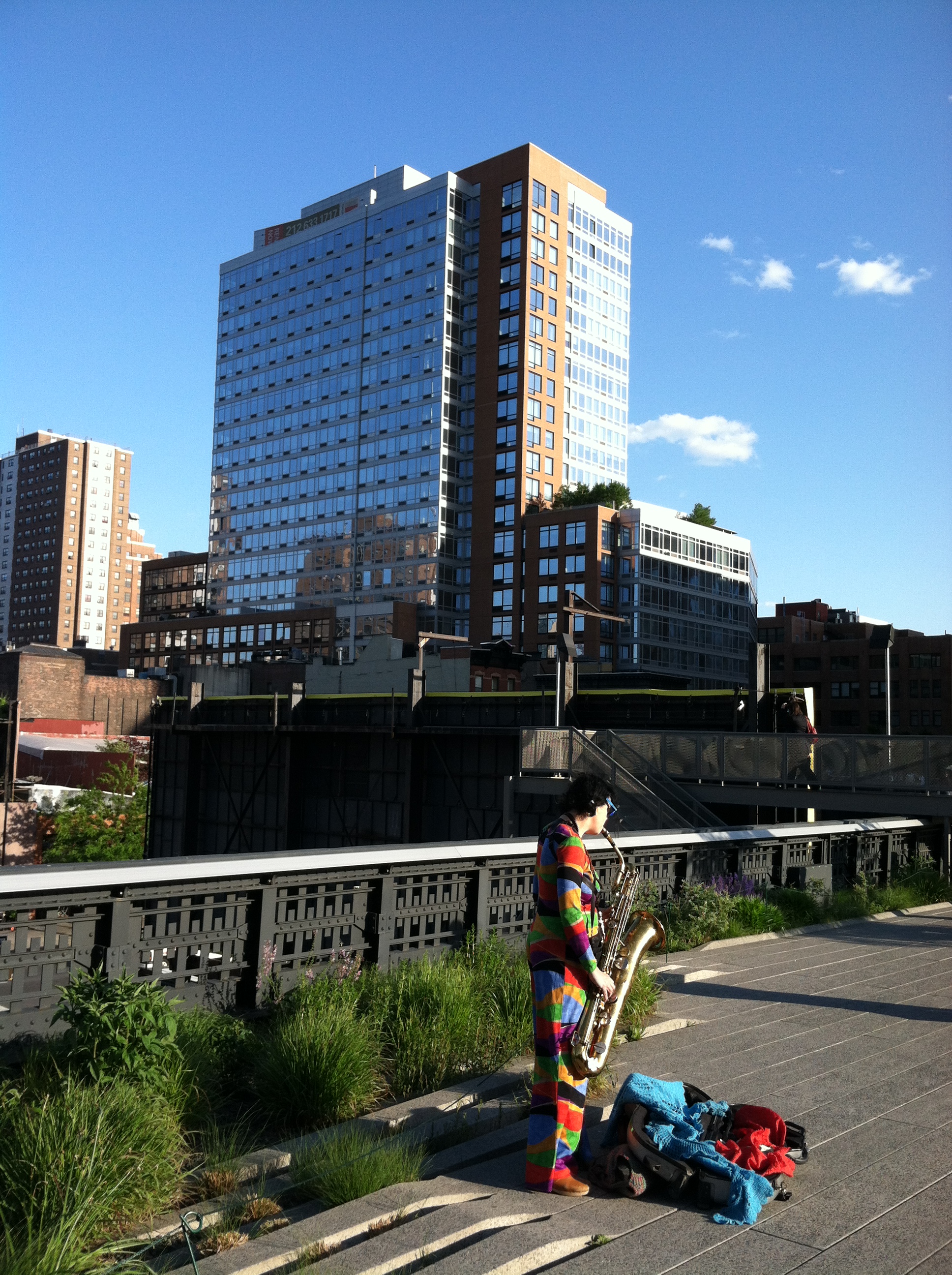
Colorful bari sax player – High Line

As some retailers move out and other areas of the city that are cheap continue to gentrify, the Meatpacking District may see a day where it’s not a “hot spot” anymore. Given how many times I drop off and pick up down there, I don’t see that happening anytime soon. Much of the city’s next hotel boom will oddly be on the Lower East Side and if zoning was ever changed, that could be fashionista central within a few years. Even the old Essex Street Trolley Terminal under Delancey Street could be reinvented as the “Low Line” – the next urban relic reinvented for a city that glorifies and commodifies the past, in the form of public-private partnerships. For now, that remains to be seen whether the trendiness of the West Side will migrate eat and reinvent a neighborhood that bridges Hipsterville with the rest of Manhattan.

“Here you go.”

“Thanks Pat.”

“Not problem. You missed it at the bar – I ended up eating the snacks that they left out on it because I thought they were for everyone seated there. Apparently they weren’t, as the people next to me gave me a look as I snuck one in.”

“Really?”

“Yeah. I had to have one since it took so long to get our drinks. This place reminds me so much of a casino even though I haven’t been in one in years.”

“It is pretty nice in here.”

“This is one of the most beautiful places in the city, just like what I heard. Such a 70’s look to it but I don’t see it getting outdated anytime soon. I know things cost a fortune in here but this was worth it. How’s your drink?”

“Good, yours?”

“It’s wonderful, but anything with Saint Germain is. Want to try some?”

“Sure.”

“You know, it’s funny. I take people through right by this hotel all the time and now it’s so odd seeing it from up here. Everything looks so small and so distant. I can see why they call this the Boom Boom room. I’m glad you’re here with me to take it in.”

“It’s nice to be with you too Pat.”

The woman I was with that night is no longer in my life but just like out time on top of the Standard, I’ll cherish our time together. It’s always nice to reminisce, even if I’m not meant to live the high life right now.

The view from the Standard

Lights Out

Still no sign of the Halloween Parade – West Village

“Hey there, where to?”

“Fulton and William.”

“Alrighty. I know the power’s out south of 34 St. Do ya mind if I take the FDR down? The less intersections I have to go through, the better.”

“Do what you have to do and get us as close to home as you can.”

“No problem.”

And so it went. The end of the above conversation was repeated quite a few times last week as many New Yorkers were forced to go home at night, even if they didn’t have much of anything there waiting for them.

Much was written about the Hurricane that the Big Apple bore the onslaught of last week and much more will be penned in the coming weeks and months as the city continues to clean up and get back onto its feet again. There was no doubt that this storm was powerful – enough so to force the cancellation of the Village Halloween Parade, the Marathon, a week of school, early voting for tomorrow’s election, and countless end-of-season festivals, street fairs, and neighborhood events. The common thread that I read about, and to a lesser extent heard in my cab, was how similar this was to 9/11, when it came to shock, awe, and devastation inflicted on New Yorkers. Upon a closer look though, that really wasn’t the case.

I was not in the city on 9/11 but was planning on going in that Tuesday since I turned 25 the day before. I went out to watch the Giants open up Monday Night Football the night of my birthday and anyone who was in the city that day can recall how beautiful and clear the sky was when the planes hit. What most people don’t remember is how it poured that Monday before, and I mean poured as in not letting up for hours on end. It was because of that that my usual trek through the city alone on my birthday had to be postponed for a day, and then for a week.

When the Towers fell, most people thought that we had reached a turning point in American History. Our economic might had already peaked, the economy would dip into a serious recession, Lower Manhattan would never recover, tons of buildings would either fall of have to be torn down in later months, and thousands upon thousands would become the first casualties of what would be dubbed the “War on Terror”. Thankfully, most of those assessments did not come to fruition as most of Lower Manhattan was cleaned up and on the road to recovery by the time the last steel beam was removed from Ground Zero 6 months later. The nation moved on, only the Deustche Bank building had to be razed, and the Battle of Antietam remained the bloodiest day in American History. History proved to be the ultimate judge of what happened on 9/11, even if the toll was still grim in the end.

Sandy turned out to be a completely different beast, as the cancelling of the Marathon proved to New Yorkers. For all of his good intentions, Mayor Bloomberg was wrong to want to go forward with a race less than a week after the city came to a halt. 9/11 was nearly two months before the race and there were only 16 acres directly affected by the planes that struck Manhattan. The last storm was powerful enough to remind New Yorkers of the giant land mass at the western end of the Verrazano Bridge and the beaches on the far side of JFK. For them, life will never be the same and it will bring into question the uneasy relationship between the far-flung reaches of New York and the economic center of the city that receives the lion’s share of money and attention.

This week’s cover of New York served as a hauntingly beautiful reminder of how much of Manhattan was plunged into darkness due to the storm and the clear demarcation line that resulted from the power outage. I had to cross it several times during my shifts on Tuesday and Wednesday nights and it was extremely difficult to imagine that it was not the first time that the lights had gone out there on such a massive scale. Anyone who could recall the blackouts of ’65, ’77, and ’03 will vouch that they were notable in city’s history for different reasons. The causes, and reaction by those stuck in the dark led to changes in infrastructure and policing in the affected areas. Once again, those will be the issues that the next Mayor of New York will have to address when the cleanup is done.

The truth is that the Big Apple is only as good as the conditions of the utility and transportation networks in it. Many historians have cited the Blizzard of 1888 as the catalyst that led to the burying of the electrical system and the creation of what later became the IRT, the city’s first underground rapid-transit system. With a fare hike looming in March, the relationship of the transit system to the patrons who use it will be under increased scrutiny over the winter as the final numbers are worked out. New Yorkers hate having to dig deeper to get on a bus or train for what they feel is a lack of return for the extra money being shelled out. What many of them don’t realize is that the system is so expansive and antiquated that any lack of a fare hike will only hurt in the long run. Having to maintain and expand the mass-transit network will be important in the future as the price of oil will remain high and the policy of developing the waterfront and using ferries to haul passengers between the glistening new towers will have to be looked as closer. Sandy reminded us that New York is quite an expansive locale and all areas will have to be kept in the fray for the city to remain competitive and desirable for those looking to live there. Having the Rockaways cut off from the mainland will not just affect those who live there, but will serve as a black eye on the administration as a whole, showing the world that it cannot afford to provide basic necessities for those on the periphery.

In the coming months, the Macy’s parade will weave its way through the West Side, the tree at Rockefeller Center will be lit, and the ball will drop on New Year’s in Times Square. The people watching these events on TV will undoubtedly be touched by the heartwarming resolve of the people of New York but what they won’t see are the Sandy’s of the future that threaten the Big Apple. Fault lines under upper Manhattan could awaken at any time, rising sea levels would permanently wipe out much of Zone A, and any number of terrorist plots could expose fragile grids and people’s nerves that are still in the process of healing. The real resolve of New Yorkers will not come in getting the next holiday celebration off without a hitch, but whether they have the patience and fortitude to address long term environmental, infrastructural, and sustainability issues before the City gets to the point of no return.

Right PSA, wrong city pictured – Murray Hill

A checkered past

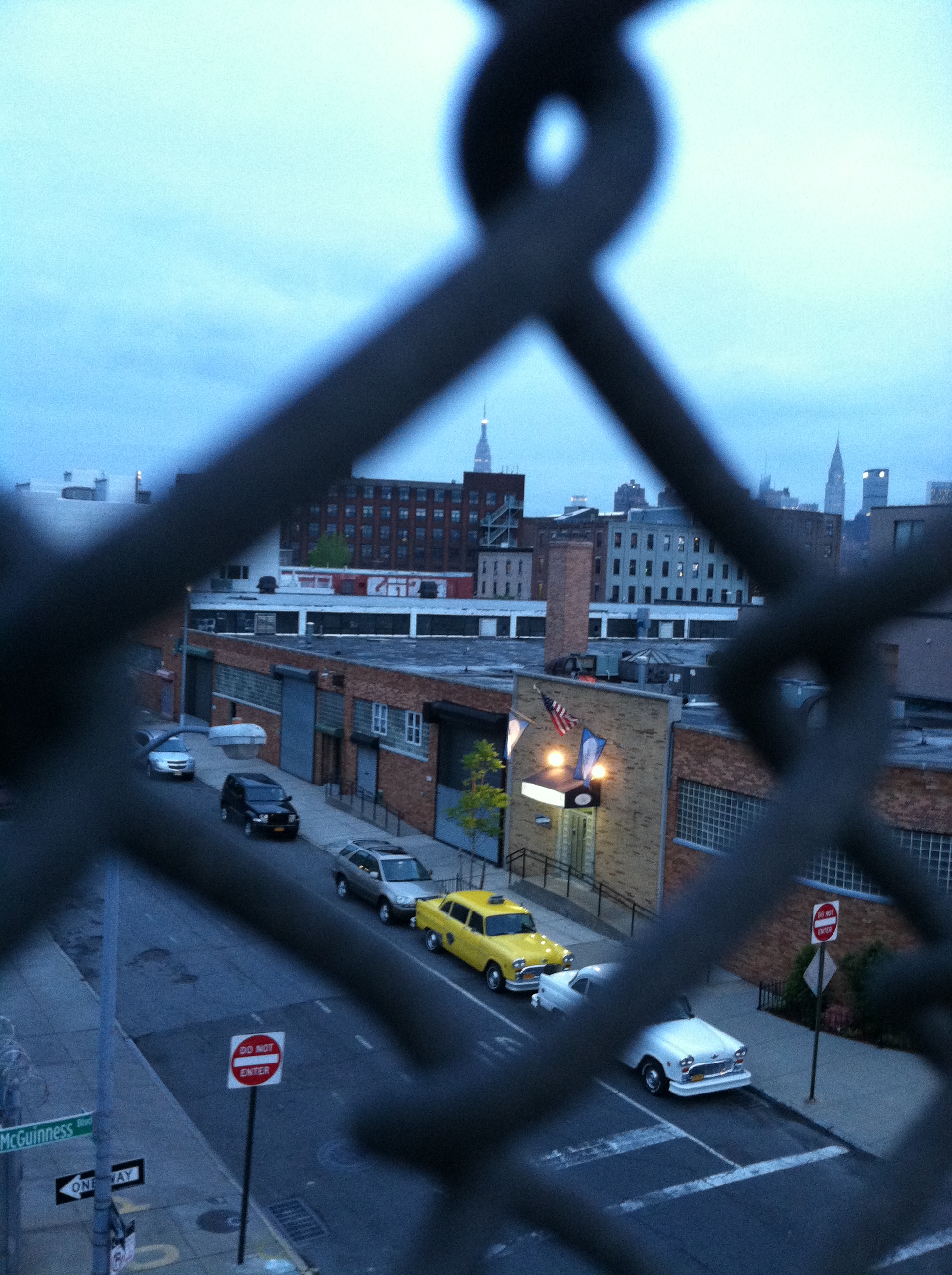
Checker Cab – Greenpoint

The fare hike that went into effect last week came and went without a lot of fanfare. Much was written about it over the summer when it was debated at a series of TLC meetings but many New Yorkers thought that those in my profession were due for a raise that was a long time coming. The big debate was not how much to raise the fare but what percentage of it would ultimately end up in the driver’s pockets and not in the hands of the medallion owners and garage operators. Lost amidst the hubbub of the hike and the throngs of groggy commuters returning to work this week was the other change that coincided with the new rates – that being the new logo on the side of the Taxicabs themselves.

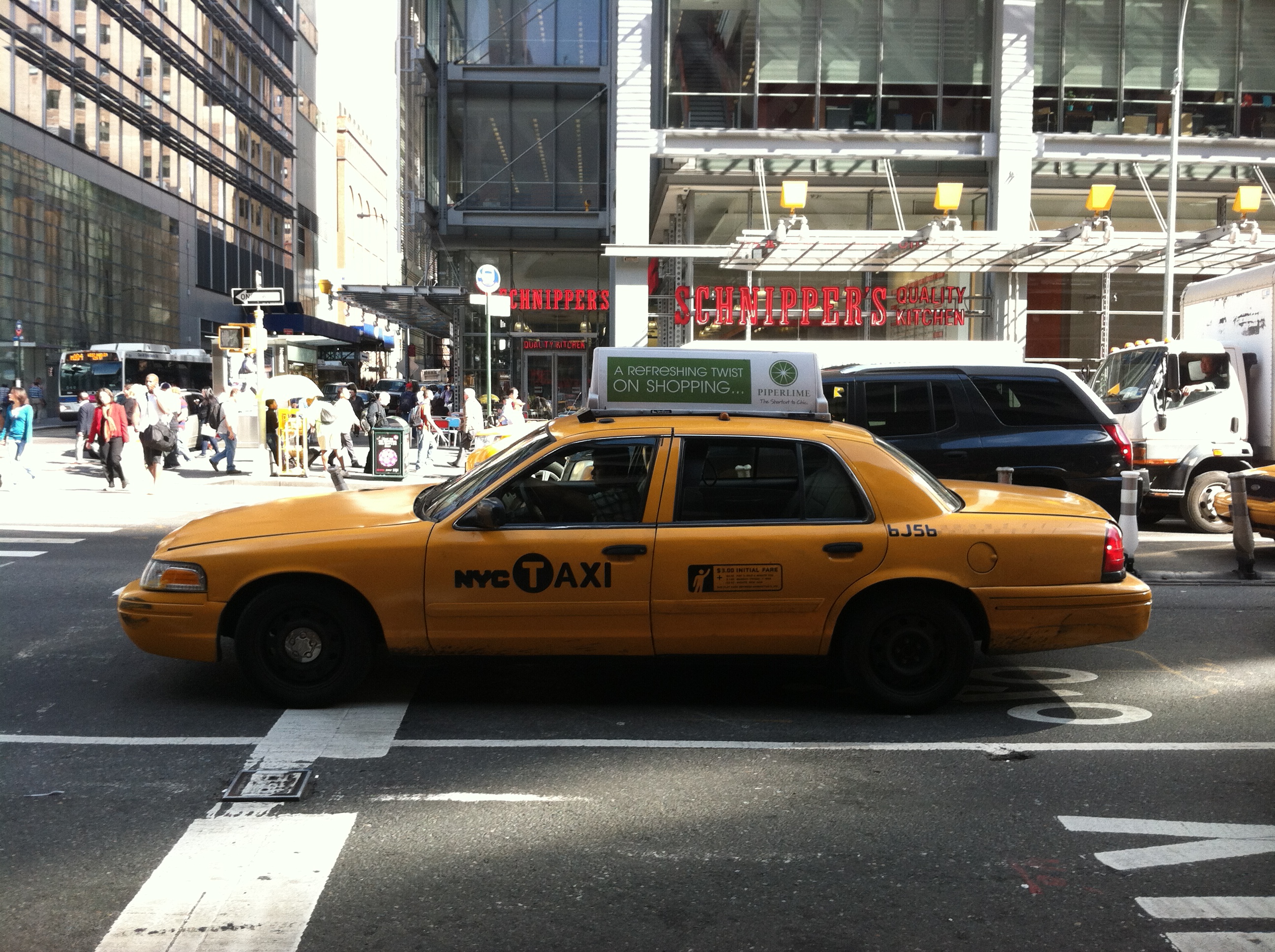
The old Taxi look

For the last few years, all of the Taxis in New York had the look seen above, with the “NYC” in the official font next to the Taxi logo on the front door and the rate chart on the back door. On the back of cab was the strip as I call it – the checkerboard pattern that was found on cabs back when an actual company called Checker supplied the cars that roamed the city streets. As the models where replaced and the company went out of business, the pattern became smaller and smaller over the years, until it was finally relegated to just a tiny reminder of the way things used to be.

Until the fare went up last week.

The new Taxi look

This is how your ride in a yellow cab will now look on the outside. The “NYC” that was so prominent has been shrunken down, the fare chart has been simplified to two symbols, and the work “Taxi” has been replaced by a big, black “T”. The thinking behind it is that New Yorkers, and visitors, should know what a yellow vehicle that doesn’t carry kids around all day should function as, so why bother labeling it as such? All of the marketing wizards could do was come up with this but I guarantee that a bunch of us who actually drive the vehicles all day could design something just as informative and not charge the city an arm and a leg for it in the process.

What bothers me the most is what’s on the back and that would be nothing. Like the automat , the subway token, and the old “Walk/Don’t Walk” signs, the checker pattern on a Taxi has now been relegated to the dustbin of Gotham’s past. In order for the Taxis to charge the higher rates, the exterior had to be changed along with the upgrades to the meters. A few of the cabs this past week still sported the old design, which only had one advantage: Smart New Yorkers knew that they were charging the old rates and would hail them instead of a upgraded Taxi. This won’t go on for long but given how expensive everything is today, I had a few people tell me that they were attempting to do that when looking for a ride.

Economics aside, the new design marked another indication of the homogenization and globalization of New York. Pictures and symbols continue to expand as more people from around the World continue to visit the Big Apple. The less English they have to come across, the easier they can get around. Soon, the subway will be fully automated, Street signs will get bigger than they are now, and smartphone apps will ensure that no one will ever get lost again when navigating the city. It’s bad enough that the cabs have maps, GPS’s, and endless commercials on the backseat screen, all in the name of progress. If nothing else, a Taxi should say what it is, let anyone think that a black car has the same role that a yellow one does on the city streets.

Soon, the Crown Victorias, SUV’s, and Prius’s will all be scrapped in favor of the NV200, a.k.a. the Taxi of the Future. What seemed so common today will be old hat in the coming decades as change will inevitably take hold and thrust all of us into the future. These “upgrades” will be fully present in a new fleet that will be more environmentally friendly, accessible, and better designed, but the real shame in it will be in the scrapping of what made Taxis so beloved in the past. As all of this takes hold in the next few years, one question never seemed to cross the minds of the designers:

Would it have hurt to keep the checkerboard pattern as it was?

Way out West Side

The West Side as the edge of familiarity – courtesy of Saul Steinberg

“Hey there, where to?”

“11 Ave. and 30 St.”

“Oh, that’s where the Ohm Building is.”

“Yeah, how’d you know?”

“I’m a cabdriver, we should be on top of these things.”

“Well, that’s good to know.”

“Do you enjoy living there? I watched that go up and right now, that’s the only residential tower over in that neck of the woods.”

“Yeah, that’s about the one drawback of it. It’s still out in the middle of nowhere.”

“Well, I don’t expect that to last long. Once the extension of the 7 train opens late next year, all of that’s gonna change.”

“That’s true. I have to say though, July 4th was amazing. All of us who lived there were invited to the roof deck for a big party. They had a DJ up there with lots of food and we were also given the best view of the fireworks in the entire city. It was a wonderful experience.”

“I worked that night and I’ll take your word for it. The one time I walked into the lobby, they had dance music playing and lots of lights going like it was a club.”

“Haha. Yeah, it’s pretty happening in there. Most of the units are sold and people enjoy living in the Ohm, even if it’s off the beaten path.”

“Why do you like living there then?”

“It’s a lot cheaper than the other new towers that are being built and the walk isn’t really that much farther out than I thought it would be.”

“You’re talking about a place like the MiMA Tower, right?”

“Exactly. This was a much better deal.”

“What kind of work do ya do, if ya don’t mind me asking?”

“Oh, I’m a Lawyer…”

Five or ten years ago, this conversation would have been impossible to envision. It wasn’t just because I had a different occupation, but because no one would have lived this far out on the West Side of Manhattan. Since the rental market is still too big for its britches, Manhattan has been forced to look up, and out, for expansion. What’s ripe for the taking? Of course, that would be the West Side.

Horace T. Greeley was once quoted that one had to go West for prosperity but anyone who would have taken his advice was bound to see America as Saul Steinberg pictured it in the iconic March 29, 1976 New Yorker cover shown above. When the Dakota apartment tower was constructed, it was called that because people who considered moving there may has well have moved out past the 100th meridian. Central Park West is still considered one of the premier addresses to call home today but when it was first built, the Dakota was out in the middle of nowhere…

…which also happens to be the case of the Ohm Tower. These days, buildings need flashy names, big name designers, and a star marketing team to sell them. The MiMA Tower has posters on newsstands and the few remaining phone booths touting how it’s in the middle of so many neighborhoods, since most people are concerned with where and not what or how much it will set them back per month. Real estate, of course, is only about three things – location, location, and location. Given that I have to commute from the hinterlands of the above cartoon, it’s shocking to hear how many people in the Big Apple will confine themselves to a set of parameters. Living on 97 St as opposed to 94 St or two avenues over from where your coworkers go home to at night shouldn’t be a big deal but to some, it’s more of a status symbol than any promotion or corner office that they yearn for.

The West Side encompasses many diverse neighborhoods with divergent histories but one thing has united them through the recent decades of the city’s history, and that’s rail. The opening up of the Contract 1 IRT Line in 1904 opened up the Upper West Side to development of giant apartment houses along upper Broadway that still dominated the Upper West Side and Morningside Heights to this day. Of course, the line cuts east as it makes its way down to Columbus Circle and the line that defined the Middle and Lower West Sides was actually one that carried freight. 10 Ave. was known as “Death Ave.” due to the tracks being at grade but planners like Robert Moses had something better in mind, and that was grade separation.

North of midtown, the rail line was mostly covered up by what became Riverside Park with the railyards between 59 and 72 Street having become the site of Donald Trump’s massive Riverside South Development. The Freight Line that ran south from Penn Station ceased operations in 1980 and now, it has become one of the most successful urban rails-to-trails parks in the world. Of course, I’m referring to the High Line, which has remade the Lower West Side into a tourist and recreation mecca.

In between the two still stands the last gigantic undeveloped site in Manhattan and the future site of Hudson Yards. Coach has already signed on for a 50-story tower on 10 Ave, a stone’s throw from the Ohm, but the Related Companies has much larger ambitions for the open space where passenger trains are stored while not in use at Penn Station. Cabdrivers love the streets out there for runs since they are largely free of traffic and pedestrians unless the Lincoln Tunnel approaches are overflowing. I don’t tend to find a lot of fares out that way, since the Javits Center is still a giant black mark on the city in more ways than one. Of course, all of that would have changed in an alternative universe.

I say that because the London Olympics just concluded and as many news organizations recently reminded their readers, scores of officials wanted the 2012 Summer Games to be played in where else – New York. The Olympic Village may have been in Queens along with many of the facilities in Flushing Meadows but the grand center of the whole spectacle would have been on the West Side. What was once home to the Jets of the singing sort would have housed the Jets on the gridiron once the games were over and the mess was cleaned up. Residents were up in arms over the idea of a stadium taking up valuable real estate in an area starved for parks, schools, and other amenities that would have been much more utilized by the locals.

When I was growing up, one of my favorite songs was “West End Girls” by the Pet Shop Boys. It was an example of what I dubbed the “Third British Invasion” (which also included Depeche Mode, Erasure, and New Order) – sassier, full of synth, and more upbeat than the earlier work of U.K. sensations like the Beatles, the Rolling Stones, or Led Zeppelin. It had a chorus that referred to the differences between the posh West End of London and the gritty East End that was home to a long-running soap set there and later on, the Olympic Games that I mentioned above. Back in the 80’s, the island of Manhattan was the inverse of London’s layout with the West Side was just as gritty as the East End was. The Westies were losing their grip, the last remaining section of the Miller Highway stood unused until it’s untimely demolition in 1989, and rents there remained significantly lower than on the blocks that were crosstown.

Like all things and places old, it was resigned to two fates – oblivion or renewal. In the 21st Century, it’s obvious in which direction the neighborhood is heading in. In another 20 or 30 years, it may impossible to picture the blocks west of 8 Ave as once being the home of garages, warehouses, and blue-collar Manhattanites. Many of them are pushed so much further uptown or to the Outer Boroughs now as to render the neighborhood as a blank slate upon which to build anew. Although the architecture has been some of the most cutting-edge in the Big Apple, the exclusion of the much trumped-about 99% leaves much to be desired. Parks and open space can indeed be used by all but what made the neighborhood so colorful for so long was the cast of characters that called the place home. The increasing homogenization underneath all the crazy facades and glistening towers is not something that the City should be proud of. So much of Manhattan can already lay claim to housing residents with too much in common. The West Side has always been the proverbial cutting edge of New York and still deserves to be so, even as waves of change threaten to commodify so much of what made it unique in the first place.

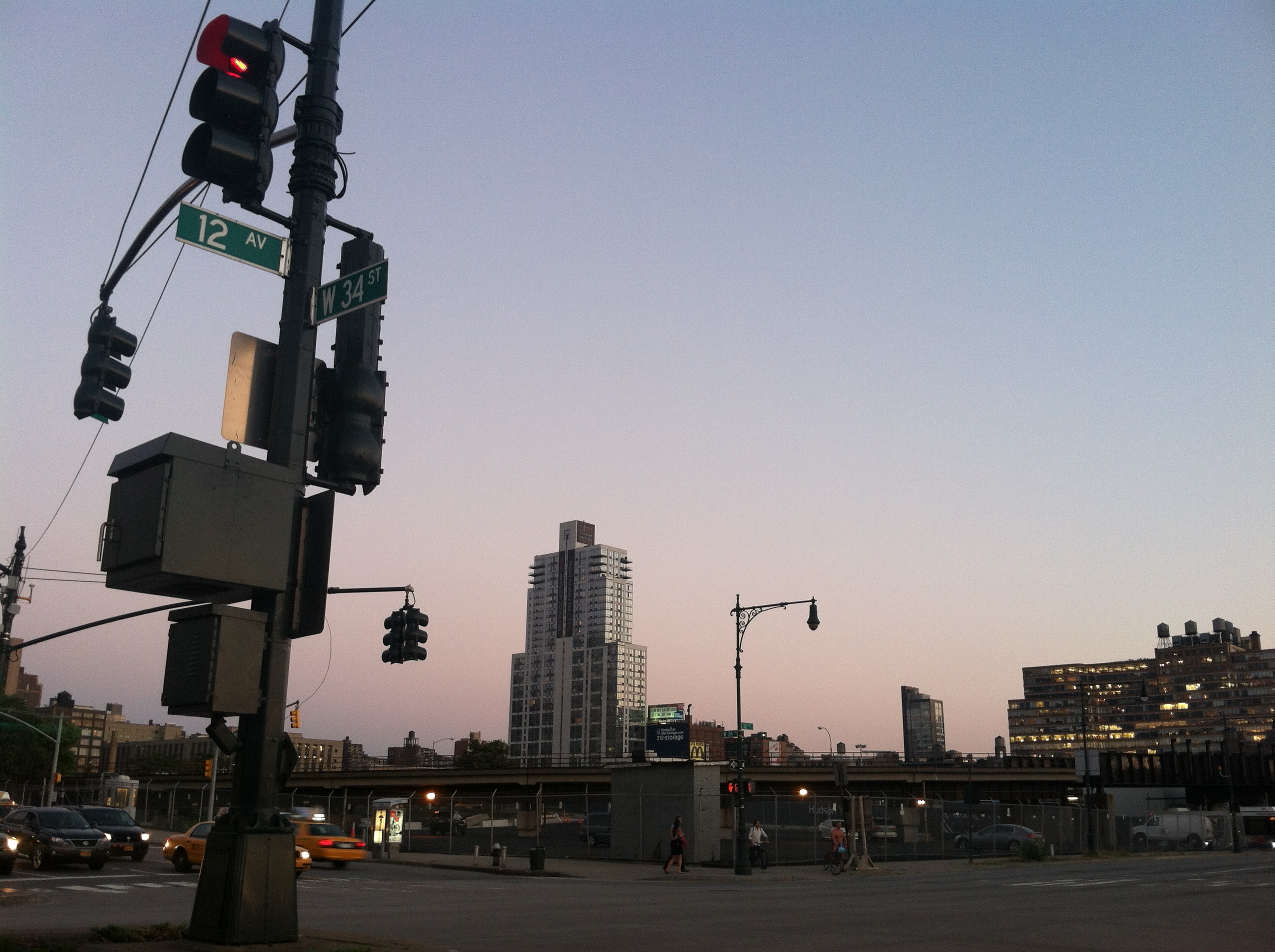
The Ohm and northernmost section of the High Line as seen from the West Side Highway

The Big App

Spotted on a phone left in my cab

It was reported last week that a new app is now out that helps passengers find empty cabs that are nearby and traveling under 10 MPH. Of course, it’s free for them download but a monthly fee for us and I’m taking a wild guess in saying that the developers expect us to recoup the cost by having enough extra fares. While this seems like a good idea, I’m not so sure if this is going to work as envisioned.

For starters, this wouldn’t ever be used by us at rush hour. Ever. Rush hour tends to be one big long fare broken up among many passengers. To be sure, I will get pulled out to the outer Boroughs now and then during peak periods but if I’m in Manhattan, it’s just one nonstop whirlwind. I have my spots where I know people are streaming out of work and eventually, that mass will work their way home or to where the social hotspots of the night happen to be. Scanning the paper and listening to my passengers is how I take the pulse of the city and once in a while, the other drivers I keep in touch with will inform me of any particular clubs or parties that are letting out and in short supply of Taxis.

Then there’s the issue of when to check our phones. Commissioner Yassky kindly reminded us in the article linked above to pull over when needing to do that but let’s face it, how many times have you seen one of us pull over, throw the flashers on, and check our text messages?

Exactly.

Hands-free devices are great for calls but there’s too many times where I have to actually pull up the screen on my phone to find out what I’m looking for. Thankfully, I have plenty of red lights to help me out with that but when cruising along, my focus is totally on what’s ahead of me and where my next fare is, since so many of them are so poor at getting noticed (hint: wave your phone when you hail – we can see them real easily!).

My bigger concern is the pace of life and how this would speed it up even more. The idea of using an app to find out where we are is great but if there’s one thing us cabdrivers know, it’s that the rules don’t apply during the lean periods. When the streets are bare, drivers will do *anything* to get a fare, and that sure includes breaking traffic laws and rules of common courtesy. The fare that’s half a block ahead at two in the morning might be someone else’s when he cuts across five lanes of traffic to claim it for himself and there’s no doubt that another cab could easily steal a fare that has already “claimed” you via the app. Eventually, someone will come up with a better mousetrap and the app in its planned form will become outdated like a Motorola phone. What would that make us?

A for-hire-vehicle, which wouldn’t be that much different than a black car…and you know how much us and them get along.

No, yellow cabs will never become black cars in a literal sense but there’s something to be said for having the exclusive right to take street hails. It’s the essence of who we are and what we do and like so many other jobs in the 21st Century, the definition of that line of work if being radically altered by mobile technology. Yes, I am guilty of that in a small way, not only because I love my iPhone but because I was actually interviewed by a company that’s currently developing something similar. It’s called Hailo and so far, it’s been a success in London. There isn’t a date yet for the Big Apple rollout will be but before that happens, yours truly will probably be involved in a test run on some way, shape, or form.

Given what I’ve said, that probably sounds hypocritical but I’m willing to give it a shot and put my own personal preferences aside. My opinions are strong but I refuse to pull a Quinn and force someone or something from being in New York without letting the people of the city decide for themselves if they want it. Ideas deserve a shot in the marketplace that is New York and even though the Taxi industry has been too slow to embrace change and technology, hopefully these new apps will make life easier for us and the riding public that we depend on every time we hit the streets.

Time Squared

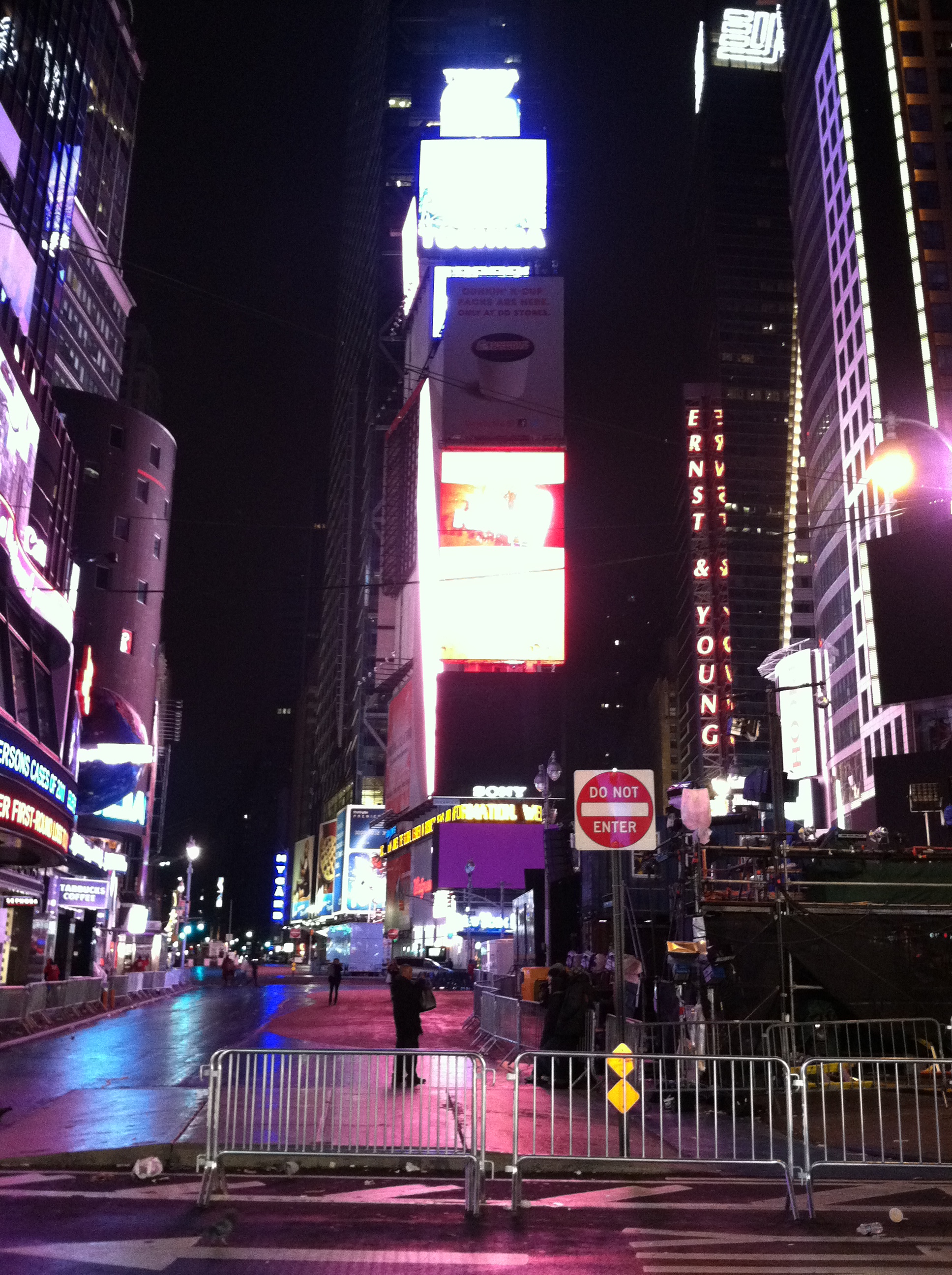
The calm before the storm on New Year’s Eve

“Hey there, where to?”

“Times Square. We want to see the Lego store, M & M World, and the Toys R Us there. Do you know where they are?”

“Of course I do, I’m a cabdriver.”

“Great. Our son’s never been to those before and he wants to see them.”

“Well, he’ll have lots of company. I can guarantee you that.”

There is probably not an part of the city that draws more people to it than the area around the convergence of Broadway and 7 Ave., more commonly known as Times Square. Named after the newspaper that was formerly headquartered in the building in the center of the above image, it has undergone more change than any other neighborhood in the city over the course of the 20th Century. When the original Times Building first opened, it was the tallest structure in the vicinity and nowhere near where the other newspapers were based since those were all clustered around City Hall. The IRT changed all of that by beginning the first waves of growth and dispersal of Manhattan’s population but what many don’t realize was that the original Times Square station was a local only stop and didn’t become an express station until the completion of the dual contracts station over a decade later.

Over the following years, the fortune of the neighborhood mirrored that of the City as a whole. Hotels and theaters popped up in the roaring 20’s, V-E and V-J days were celebrated by tens of thousands there during World War II, movie premieres on the east coast took place there in front of throngs of onlooking fans, and as white flight drained the city of vitality and tax revenue, few areas took a worse blow than the neighborhood that was built on performances that were staged indoors and spontaneous outdoors. All one has to do is watch Midnight Cowboy, Taxi Driver, or the opening scene of Shaft to see how far Times Square had fallen into disrepair. When I was growing up, it was something to avoid and I can still remember my Mom forcing me to look straight ahead as we walked back toward the Bus Terminal to head home.

It was around that time where the State and City moved in to take over many of the dilapidated properties and turn the area into a redevelopment zone. The first phase saw such projects as the Marriot Marquis, 750 7 Ave., and 1585 Broadway transform the northern half of the “bowtie” into a corporate canyon and the dot-com boom and growth of new media fueled the construction of the headquarters for Conde Nast and the North American base for Reuters,  among the new towers in the southern half of the Square. Even the New York Times got in on the act, as they moved out of their 43 St. offices and into a brand-new Renzo Piano skyscraper on 8 Ave. in the middle of the last decade. For all of the clamor to clean out the smut and restore it to it’s former glory, a funny thing happened once crime declined and families were able to trek through the area unscathed:

Some locals missed the old Times Square.

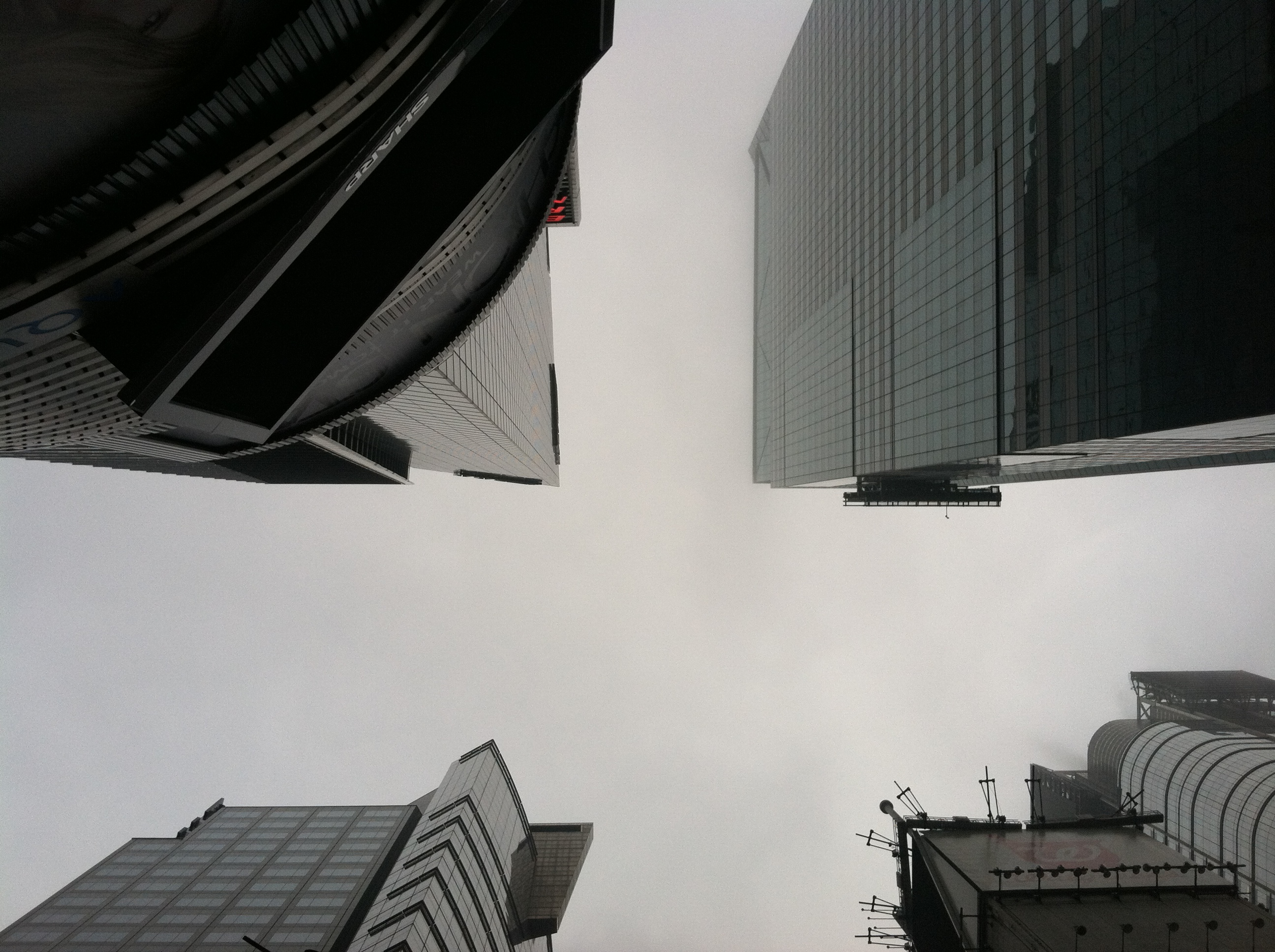
Times Towers (clockwise from upper left) –  Ernst & Young, Times Square Tower, Conde Nast, and Reuters

One of the great debates among New Yorkers now is whether they like the 24-hour three ring circus that the crossroads of the world has become. Many are nostalgic for the grime and grit that can no longer be found there. The three-card monte players are a thing of the past, Howard Johnson’s and Nathan’s  are no longer in the neighborhood, and the only women of ill repute can be found coming out of Lace and Flashdancers. Even the video arcades are long gone, as kids like the one who came into my cab last week now have commercials masquerading as stores to separate them from their money.

What New Yorkers complain about the most isn’t the three-dimensional reconstruction that took place over waves of economic booms, but the two-dimensional one whose tentacles have quietly overtaken the city during the great recession. Of course, I’m referring to the bike lanes and pedestrian plazas.

It’s not the first time the traffic flow has been altered on the streets of Times Square, as any pre-195o’s picture will attest to. It’s hard to imagine now but at one time, the avenues of New York had *two* way traffic. Think it’s bad on 5 Ave. now? Try having oncoming vehicles make a left turn as you cross a busy midtown intersection. In the mid 1950’s, the avenues were converted to one way and even today, I still groan when I have to take 3 Ave. in the East Village and have half of the vehicles in front of me attempt to make a left turn.

The new changes in the flow of people have riled so many because it’s the most visible example of the “us vs. them” battle that has emerged in recent years. Planners vs. users, Bloomberg vs. commonfolk, bicyclists vs. cars, locals vs. tourists. All of them have an agenda and as the neighborhood became more crowded throughout more of the day, space became more of a premium. As more buses hauled more tourists in and the pedicab industry grew, they had to compete with record volumes of traffic in a smaller amount of space, since Broadway was now cut off between 47 and 42 Streets. Locals may have opted for alternate ways to get around but as skyscraping hotels and flagship stores opened up, more people from out of town had more reasons to decamp in Times Square when visiting the Big Apple.

Because so many people eat, shop, and seek entertainment there, it’s only natural that the square is one of the moss-photographed sections of the city. Of course, it also means that I pass through it more than just about any other neighborhood during a typical shift. What was crowded early may thin out a few hours later and then crowd up again later in the night if a demonstration or roadwork clog up 7 Ave. during an off-peak time of the night. There are few other parts of the city where the difference of 20 or 30 minutes can be like night and day, even if the stars in the sky are perpetually blotted out by the bright lights of the signage. The turn restrictions and closing off of Broadway make Times Square nearly impossible to escape from during a jam and with so many people hailing cabs there throughout the night, keeping up with the traffic there is always a game that the driver can’t afford to lose.

The drama still takes place there as it has throughout much of the neighborhood’s history but like so much on TV today, it all seems scripted. The same tourists from the same parts of America will come and see the same Broadway plays that their parents saw or their kids will see in a movie theater. They’ll eat at the same chain restaurants and visit the same stores that they can find near a mall back home. Everyone will want his/her picture taken with the Naked Cowboy and the women who dresses up as the Statue of Liberty and they’ll spend their money on the street”artists” selling the same variations of 10 pictures and cheap t-shirts made overseas. They’ll even comment on the camera store that’s “Going out of Business”, just as it was 20 years ago.

Only the astute cabdriver will be fortunate enough to pass through the same streets and not have the same experience. The people in his cab will be from all corners of the globe, no two of them will want the same take on the homogenized experience as the last person who wanted to go there, and every passage through the Square will be different than the one before it, just as no two boards on Frogger are quite alike. A few sharp-eyed people will notice that the ball that’s dropped on New Year’s Eve is permanently on displayed on top of the old Times Tower, ready for it’s close-up on New Year’s. None of them will think that Groundhog Day (a la the Bill Murray movie) would be more appropriate to celebrate there, since the entire effect of Times Square is that of a shopping mall set in the urban fabric of New York. For a part of the city that many consider to be its heart, the Big Apple deserves more than the pacemaker that it ended up with after all the redevelopment.

No wonder they hate us – Times Square

Hold On

The start of my shift from the start of it all last July

Last week was not unlike many of the others that I’ve had lately. Lots of tourists from overseas flocked to the Big Apple and helped cabdrivers like yours truly out. There was a Taxi Worker’s Alliance meeting late at night to celebrate our hard-fought raise that goes into effect in the beginning of September. Someone on Friday night even stood in the middle of Broadway and stopped my cab, opening the shotgun door and demanding to go to the heart of the Lower East Side. Of course, my passenger in the back freaked out and I soon gave the drunkard a verbal tongue-lashing before he slammed the door and continued to make an ass out of himself with the other Taxis heading downtown. Once I brought my wheels back to the garage at around 6 yesterday morning, someone else happened: I hit the one-year mark as a New York City cabdriver.

Of course, there wasn’t any fanfare. My new hack license came in the mail two weeks ago and I filled out everything way ahead of time, to avoid the possibility of bureaucracy giving me an unplanned vacation in the middle of the summer. As I’ve alluded to earlier on here, one half of Taxi drivers don’t last a year and another half of them don’t make it to two years. When I started, I had no idea how long I was going to last because of circumstances that were beyond my control. I switched my major enough times during my two stints in college and the question that I’m asked most often as I navigate my way through the city streets is what I want to do with my life.

Besides strangling the necks of the passengers that get their jollies out of playing “20 questions” with me, I never have a definitive answer to that. 15 years ago, I would have said that I’d be an engineer. 10 years ago, I would have wanted to be an architect. 5 years ago, an economist. 3 years ago, an urban planner. Now, I just want survive this long enough to pay my student loans off. There have been too many articles lately stating that America is largely becoming a nation of dependents. Kids dependent on overbearing parents that don’t give them any room for creativity or free, unstructured time. Aging baby boomers dependent on younger generations to provide them with care. Migrants to this country dependent on the government to provide them with social services that will last until the grave comes calling and who can forget the jobless, looking in the mail every month until the unemployment checks come and tie them over for another few weeks.

I refuse to be a part of any of that. Sure, it’s not easy telling people what I do for a living, even when I’m imbibing during another social gathering with my fellow Columbia alums. It would be even harder for me to let go of my proverbial bootstraps and throw the towel in. One thing I have to remind my passengers is that I do *not* work for the garage that maintains and dispatches my vehicle. It’s a crude form of an independent business that myself, and the other drivers, run when we head out onto the streets and attempt to better our situation. Many of us sacrifice what’s important in order to drive and that would of course be free time.

There have been several weeks lately where I’ve spent more time in the Empire State than the Garden State and I don’t even work 7 days a week like many of my fellow drivers. One of my running jokes with my passengers is that they don’t step into my ride for the night but rather, into my office. I don’t have a desk but like so many who live on wheels, most of what I need to function comes with me every time I head out for a shift. I nearly lost it all last winter when someone at a high-end apartment building on the East Side took my bag out of my trunk along with the luggage of the passenger that I dropped off there. Thankfully, the doorman was first class and was able to find my information in my bag and contact me, saving me the time and expense of having to piece my vocational supplies back together again.

As much as people think I see X-rated acts and characters out of a Larry David series on a daily basis in the backseat, stories like the one above are much more commonplace for someone in my profession. The door on the side of the Taxi may as well be revolving since people come and go so quickly and as fast as the turnover of passengers is, so is the rate at which we go around the city. I’ll cover every corner of Manhattan and probably half a dozen neighborhoods in the outer Boroughs on a typical night and if someone forgets a phone or has to go back to where they originated from, the city will shrink down to nothing as I’m forced to fly my way across town to remedy the situation. Cities need to be seen on foot to be truly appreciated but in my line of work, the sights outside of the cab are secondary to the lives and interest stories that unfold inside of the vehicle. For the way that each fare begins as similarly to the one before it, the endings are just as varied as the people that live their lives inside of the city limits.

I wish I knew what the next year will bring. There will no doubt be more interesting people who will be fortunate enough to grace my presence after having come out of nowhere, unannounced. The economy will hopefully begin a real recovery once Europe gets its act together and we figure out who will be running America for the next four years. A real set of mayoral candidates should emerge from the sorry state of wannabes that are currently making waves on the airwaves and hopefully, the cranes that are beginning to dot the sky in midtown will make their way west and finally begin to transform Hudson Yards into it’s self-proclaimed “next great neighborhood”. I’m too nostalgic for the New York of my childhood which shaped the mindset that I have today, but only because the city hasn’t quite figured out what it wants to be tomorrow. Bike lanes, new neighborhoods in the outer Boroughs, a million freshly-planted trees, and a greener economy will only make a lasting mark if they are successfully used, loved, and integrated with the permanent cityscape that the likes of Moses, Olmsted, and Corbusier have left for us to preserve and improve upon. What my role will be in shaping the Big Apple of tomorrow remains unclear but for now, my job is simple and that is to help the people that live, work, and visit New York partake in the city and help shape it for the inhabitants of tomorrow.

One fare at a time, of course.

The blur of cabdriving

Get out

Where ejected fares go to die

“Hey there, where to?”

“York and East End.”

“I beg your pardon?”

“York and East End Ave.”

“Sir, that’s impossible. Those streets are parallel.”

“Okay, just give me one second.”

So I did. I remember making the turn off of Broadway to start heading uptown shortly after taking this fare in. As usual, throngs of amateurs were out on that Saturday night, desperately waving for a ride in a vehicle such as mine while I had to make sense of a person who apparently had none of his own.

“Any idea where you’re going sir?”

“York and East End.”

“Maybe ya didn’t understand me the first time. I need a real address, or a building name, or a street number, or something I can pinpoint.”

‘Please, just give me a few more moments.”

Which the next red right gave me. Once I made the left turn past The Alamo it was time to straighten this out:

“Last time – where am I taking ya?”

“I know it’s on York and East End…”

“Get out.”

“What?”

“Ya heard me.”

“What about the meter? I owe you money.”

“I don’t care. It’s obvious that you’re on something and ya don’t know where in the hell you’re going. Just get out.”

“But…”

“GET OUT!”

And so he went…

I’m a nice guy. Really. I am. For all the crap we put up with week in and week out, it takes a lot of to get me red in the face. I don’t even like kicking people out of my cab and it can be incredibly difficult to do, given that we cannot physically pull anyone out of the back seat and that it’s easy for a passenger to file a complaint against a rude or uncourteous driver. There have been countless instances where I’ve had to deal with rich bitches, oblivious hipsters, clueless tourists, and those who pull the average IQ of an American down a notch or two but one thing I have to remind myself over and over again is that “All this too shall pass” and the high turnover rate of a typical shift will soon render an ignominious fare into a memory.

Then there are a few fares which continue to stick out for the wrong reasons. With apologies to Emma Lazarus, the city has continued to give me it’s tired, poor, heartless, strung-out, moronic, and just plain stupid, all in an attempt to get somewhere while ultimately going nowhere in the end:

“Hey there, where to?”

“Penn Station.”

“Alrighty. We’ll jump onto the Henry Hudson and get off somewhere in the 30’s. Do you have a preference as to which entrance you want me to drop ya off at?”

“I’m not sure, I’m supposed to meet someone down there.”

“Oh, is it a friend?”

“Yeah, he has the money I need.”

“What?”

“I was in a cab before and ended up here. I didn’t have enough to pay the driver so he kicked me out here on 125 St.”

“So you’re not taking a train from Penn Station?”

“Yes.”

“And you don’t know where your friend is down there?”

“Yes.”

“And let me get this straight, you got into a cab and expected the driver to take you all the way down to Penn Station but you don’t have any money to pay him with?”

“Actually, could you help a brother out and spare me a dollar? I don’t have…”

“Get out.”

“Just…”

“GET OUT! For God’s sake, PLEASE don’t pull something like this on your driver again…”

“Okay!”

And off I went back downtown…

It’s incredibly difficult at times to figure out which fares have “disaster” written on them before they come into my Taxi. There are parts of town and times of the the day that lend themselves to finding characters that are more shady, but some of the best people I’ve ever picked up were standing all alone in the most desolate and forlorn areas of the city, grateful that someone had come out of nowhere and stopped to take them home at the most forsaken hours of the night. What bothers me is that many of the people that I regretted picking up were in the midst of others who were hailing at the time, beating them out for the privilege of testing my patience.

Thankfully, that’s the only saving grace from these horror stories. As so many people do with the dating scene in New York, it’s easy to dump someone and move onto the next one when it comes to fares. For every person I’ve wanted to toss, there have been scores that I’ve wanted to have for an extended period of time. There’s nothing like talking economics with a financial whiz, current events with a city government employee, or hearing a designer, planner, or scientist talk about what he or she is working on and when the project will be complete. It’s hard enough to concentrate on the street ahead of me sometimes but it just be just as difficult to find out as much as possible from a fascinating passenger in a 5-minute span, choosing what I want to ask and soaking up as much as I can from what the person is saying. If Einstein was a cabdriver, even he’d be amazed at how quick most fares went while the few stinkers seemed to take up a disproportionally long time to resolve.

When I first started, I had no idea that so many New Yorkers would brighten up my day week in and week out. I figured that half would be decent to take to their destination and that I’d be able to stomach the rest. Two weeks in, I knew that 85% of them were a pleasure to deal with, 10% were rough, but bearable, and that 5% needed a real good smack where it counted. All these months later, that ratio hasn’t changed; only the way I’ve dealt with them has.

Last Saturday was one that seemed relatively typical for the summer. The air was on most of the night, lots of locals were out on vacation, and tourists could be found everywhere until the wee hours of the morning. If you consider the bridge and tunnel type to be one of them, then this is how one of them proceeded to treat me:

“Hey there, where to?”

“Yo, I’m going back to New Jersey. I just saw the new Batman movie!”

“Okay, where in Jersey?”

“I’ll give you $100, look my name is even Bruce Wayne! Hold my Red Bull for me…”

“Um…”

“I’m serious! Where’s the light in this thing?”

“Where in New Jersey are you heading home to? I have to enter it in before we pull out…”

“I’m Bruce Wayne, you have to take me!”

“Here, take your drink and…”

“I’ll give you $200, just take me home.”

“Sorry Bruce.”

“What?”

“Get out.”

“But I…”

“GET OUT!”

“Okay, okay!”

Needless to say, I never figured out if Bruce, his Red Bull, or his teenage friends ever successfully made it out of Gotham. The real hero of the night had other people to help home, even if his crusade was only for sanity in a maddening city.

Storm the Bastille Day

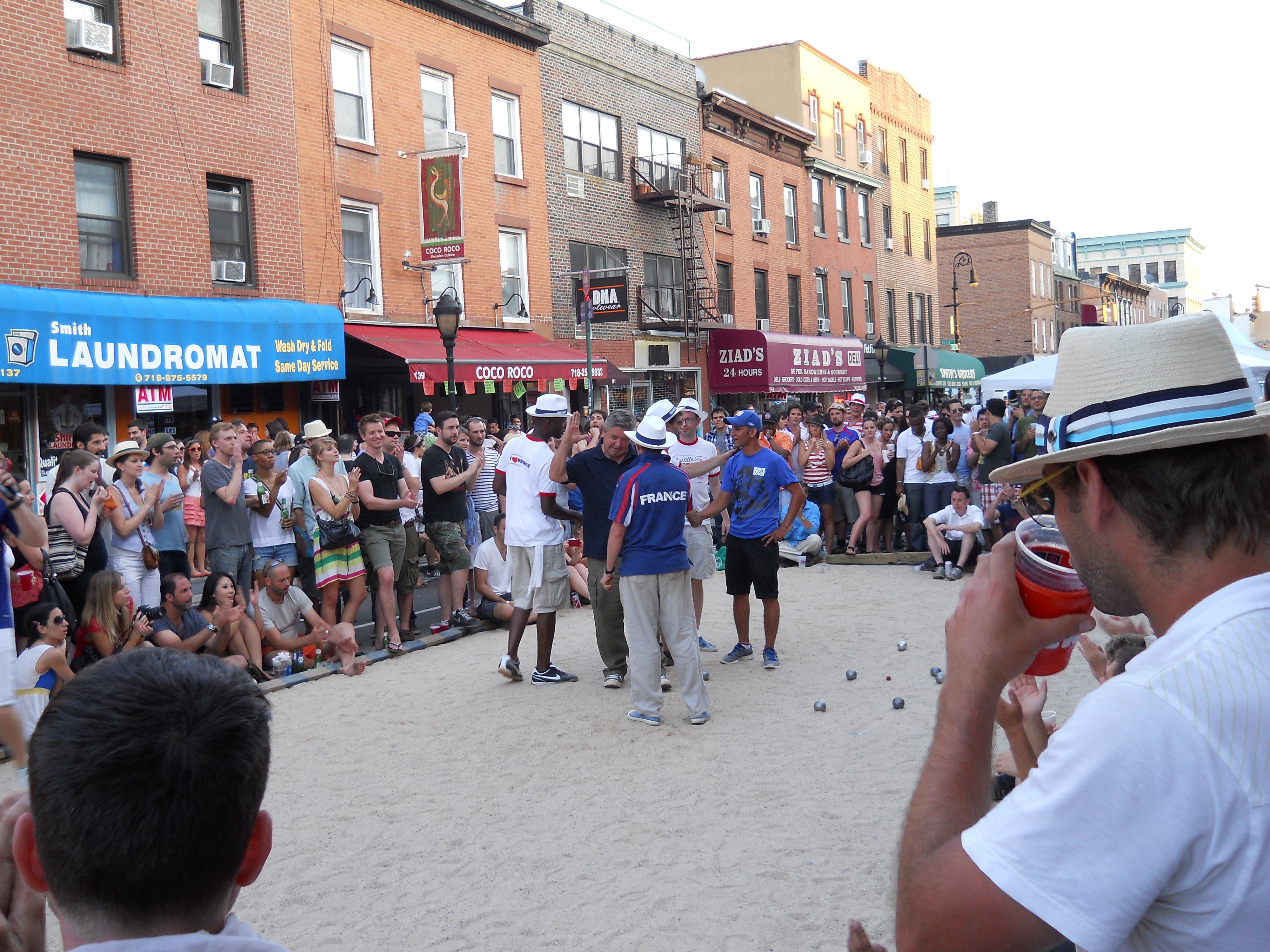
2011 Bastille Day Finale – Cobble Hill

“Do you hear a loud boom? I think I just heard another one.”

“I don’t hear anything. Oh wait, look at that!”

“It looks like fireworks coming from the Park.”

“I wonder why they’re shooting them off from Central Park.”

“Who knows? Maybe it’s for Bastille Day.”

Sure enough, it was fireworks coming from the direction of the Sheep Meadow. After I dropped off this passenger, I soon found out from my next fare that the Philharmonic was playing in the park that night and as an attempt to draw more patrons in, a post-concert pyrotechnics display concluded the night’s festivities. Although it paled in comparison to the show that Macy’s put on two weeks earlier, it was certainly enough to get my attention as well as everyone else’s who happened to be shooting crosstown on 57 St.

With so much going on in the Big Apple, I incorrectly guessed the reason for the visual and aural display. Every week, there’s another parade, festival, or commemoration for a person, anniversary, or country and one of the perks of working in the Big Apple is that every nation on Earth gets its moment in the sun at least once a year. It may be overkill at times and a pain when major streets in the city get blocked off, but they all serve as reminders that we’re a nation of immigrants that came here in search of a better life.

Obviously, I was off the mark in the conversation above and it shouldn’t come as any surprise as I’ll admit that I’m not the least bit French. Not by birth, not by association, and certainly not by marriage. While I do have a craving for Brie and Moet, those are not the types of food and drink that I tend to imbibe on and I can’t speak a word of the language, even though French is similar to the Latin that kept me up many a night in Butler Library. With this in mind, I write today in celebration of the one French custom that has helped me through many an off day and night that has dragged on for far longer than a typical shift:

Petanque.

Loosely translated, it means “feet grounded” and is a game similar to bocce; except that it’s not. I only started playing two years ago and like so many others in New York that take up a sport as a form of recreation, I picked it up off of the street…er, park.

Bryant Park, that is.

Long before I stopped cursing at Yellow cabs and actually drove one for a living, I passed through Bryant Park. I didn’t recall what it was like in the 1980’s since like Times Square, it was an area to be avoided at all costs. However, the 1992 renovation brought new life to the space and the inclusion of a reading room, public restroom, and great lawn made the place ideal for passing through at all times of the day. Every time I left the Bus Terminal, I passed through it to reach most of Midtown; even if I had to go a little bit out of my way. Over the years, it became the start of many of my pavement-pounding days and it eventually became the nexus of my outdoor time in New York. The grid that had defined the street layout in New York was continued inside the park, as the rows of trees, pathways, and a centrally-placed fountain brought out the best in French landscape architecture, while allowing for lots of fauna to fill in the spaces and throw in just a hint of disorder to the regimented layout.

Of course, what would suit a place like this better than a game that was French in origin?

The few times I saw players partaking in it, they were old and looked like the bowlers that were in my leagues back in the day here in Jersey. For years, I was called “kid” every time I burned the other team or made 6 spares in a row and that’s how I felt here, watching the seasoned veterans battle each other out boule after boule. Like so much in life, I decided to give it a go one day, when the sun was shining bright and I didn’t have the weight of the academic world at Columbia weighing me down anymore. I walked over, signed up for a free lesson, and started tossing the metal balls at the jack one at a time, when it was my turn.

As as they say, the rest was history.

Like so much in life, it quietly grew on me. One session turned into a few weekly practices and eventually, I joined LBNY. For someone who didn’t have a home in New York until I drove one figuratively on wheels, the game gave me a reprieve from the City that turned out to be one of cold shoulders, instead of big ones. To be fair, many of the players were French and had the game ingrained in their blood but over time, I found out that the diversity of the players was as great as the city itself. Young, old, working, retired, near, and far – it didn’t make a difference. The game quickly became greater than the sum of its parts players and soon enough, I found myself with boules in tow going around the city for a bunch of tournaments.

None of which was greater than those clustered around Bastille Day.

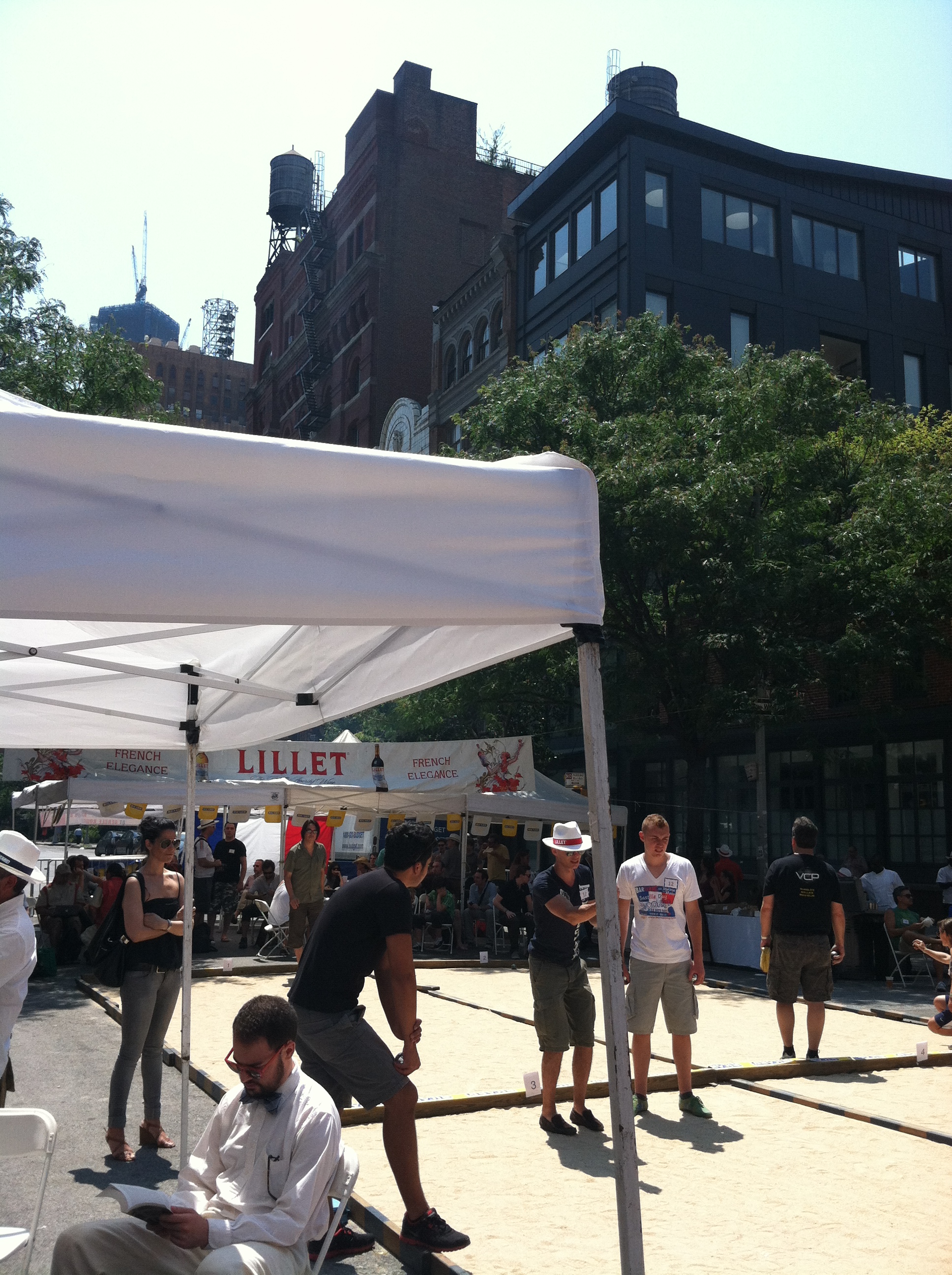
Bastille Day Tournament – TriBeCa

My textbooks at school taught me that the Bastille was a French prison that was stormed in 1789 and set off the waves of revolutions that led to the modern-day republic. The tournaments I attended did have a guillotine for display purposes but focused more on modern culture and French-inspired jazz that has been overlooked in this country. To be fair, I knew that I was a neophyte at the game and a majority of the players who excelled at it spoke French and exhibited the customs of it during the games.

Sure enough, that rubbed off on me too.

For all of its similarities to lawn bowling, Petanque is indeed an egalitarian game. What’s in? What’s out? You moved! I did not. My boule is closer! Oh yeah?

Just like cabdriving, it’s a mindset that seemed so alien to me until I played competitively and started to act like everyone else. New York excels at taking people from all corners of the globe and making them assimilate with their peers, if they choose not to self-segregate and not selectively associate with others of their own race or background. Since I grew up in such a homogenous place, it was easy for me to adapt to my surroundings when I left here, since I never really had a tie to where I came from. It’s probably why I’ve always liked seeing new neighborhoods and places when I was on wheels, even though I stuck out like a sore thumb quite often.

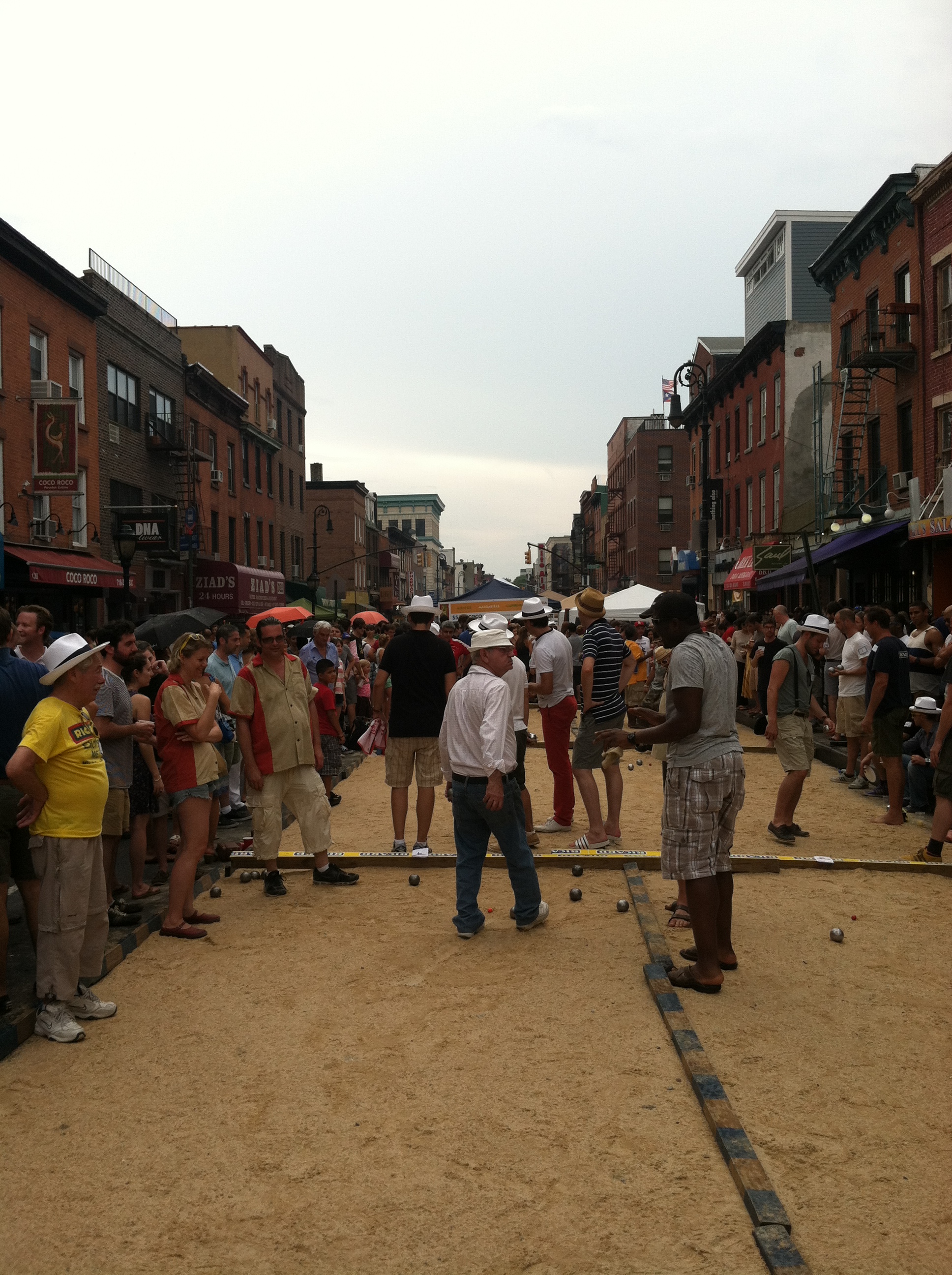
Last week was the one where all of this year’s Bastille Tournaments took place and of course, I hung up my keys for a few days and reacquainted myself with tossing the boules on sand. I said “fromage”, puckered up for some Ricard, and to be fair, did my fair share of arguing and belting out our point total in French after enough hard-fought rounds. It was hard to believe that I was on streets that I had passed through time and time again after dropping fares off, only because I was on the other end of the street closings that harden both the urban and my physical arteries when the days get long. No matter – there weren’t any trophies in it for me this year but once the games were over, any animosity I felt towards any players went by the wayside and my next shift at work was just that much easier to handle once I pulled out of the garage.

Bastille Day Tournament – Cobble Hill

Speaking of that, I certainly had a night to remember after dragging my burnt and parched body home from Smith Street last week. The hot weather lent itself to a lot of short fares since most people were too drained to walk more than a few blocks. After a pile of runs on the West Side, I took a family from Columbus Circle over to Central Park. Then, another person had to go uptown to the Park since her previous cabdriver didn’t know what he was doing. My next fare turned out to be a couple going their separate ways and after I dropped off the wife, I turned around to ask the gentleman where he was going:

“Where to?”

“53 W 35 St.”

“Oh, that’s right by Macy’s. We’ll stay on Lex and take it down unless the traffic slows down too much by the hotels.”

“Sounds good.”

Sure enough it did, considering that those words came from Al Roker’s mouth.

After dropping off the Today show weatherman, I had a few more fares and loops around midtown before making a left turn into Times Square and braving the downtown traffic. A couple that looked inebriated stuck their hands out and naturally, I took them:

“Hey there, where to?”

“Going home to Chelsea. 7 Ave. between 24 and 25 St.”

“Sure thing, I think that’s the building with the Whole Foods in it. Looks like you two had a good time tonight.”

“We did and you know what? Bloomberg didn’t have to tell us how much to drink. Can you believe he’s trying to regulate soda here in the city now?”

“I believe it even though I don’t agree with it.”

“Well, fuck that. You know what happened when they tried that with alcohol?”

“Yeah, prohibition. It didn’t work out too well.”

“Exactly! Well, unless you were the mafia. They’ll love it if this goes through too.”

“Of course.”

Yeah, the husband was slammed and a few minutes later, made a fairly typical request:

“I need to stop at a liquor store. Pull around to the one on 8 Ave. and wait for me there.”

“Alrighty, the meter will be on while you’re in there but I can wait.”

“Do you want anything?”

“Me? Um, well…I like my Bombay Sapphire or Saint Germain.”

“Okay.”

I waited and the next thing I knew…:

“Aaugh!”

“I didn’t mean to startle you. Seriously, I didn’t. I’m sorry, I’m sorry, I’m so fucking sorry!”

“It’s ok miss, it’s not every day that someone puts her head through the partition and has her hair up against my arm.”

“Pat, please. I just wanted to say hi.”

“Hi.”

“I never see the front of a cab.”

“Well, you have.”

“I”m just so fucking drunk right now and you’re so nice.”

“It’s alright – hey, what the…”

Fittingly, this was dropped through the shotgun window of my Taxi:

No wrapping required

“We’re right around the corner in the building where Katie Holmes is stuck in but don’t worry. We’re not scientologists and we’re entering through the side door.”

Laissez les bons temps rouler.